Pilates bar exercises are a practical way to improve strength, flexibility, balance, and overall body control. With a Pilates bar and resistance bands, you can perform a wide range of movements that target your core, arms, legs, shoulders, and back.
One of the biggest advantages of Pilates bar exercises is their versatility. You can perform many of these exercises at home without needing large or expensive gym equipment. The resistance can also be adjusted to match your fitness level and training goals.
Pilates training focuses on controlled movement, good posture, stability, and proper breathing. Instead of rushing through repetitions, you concentrate on maintaining good form and keeping the appropriate muscles engaged throughout each exercise.
If you are new to Pilates, consider learning the basics from a qualified instructor before training independently. Once you understand proper technique, you can explore different exercises and create a routine that suits your fitness level and goals.
What are the benefits of Pilates bar exercises?
Pilates bar exercises can help develop strength, flexibility, balance, coordination, and body awareness. Because many movements require you to stabilise your body while working against resistance, your core remains active throughout much of the workout.
These exercises can also work several muscle groups during one training session. Depending on the movements you choose, you can target your legs, glutes, abdominal muscles, back, shoulders, chest, and arms.
Pilates bar workouts also contribute to your overall physical activity. When combined with regular exercise, appropriate nutrition, and healthy lifestyle habits, they can support broader fitness and body composition goals.
Is it possible to build muscle with pilates bar exercises?
Yes, Pilates bar exercises can help strengthen your muscles when you use appropriate resistance and train consistently. The resistance bands attached to many Pilates bars create tension that challenges your muscles throughout each movement.
Exercises such as biceps curls, triceps extensions, squats, rows, and chest presses can target specific muscle groups. Full-body movements can also train several muscles at the same time.
The amount of muscle you build will depend on factors such as resistance, training frequency, nutrition, recovery, and progression. For general strength and muscular endurance, a Pilates bar can be a useful addition to your exercise routine.
The benefits of pilates bar exercises
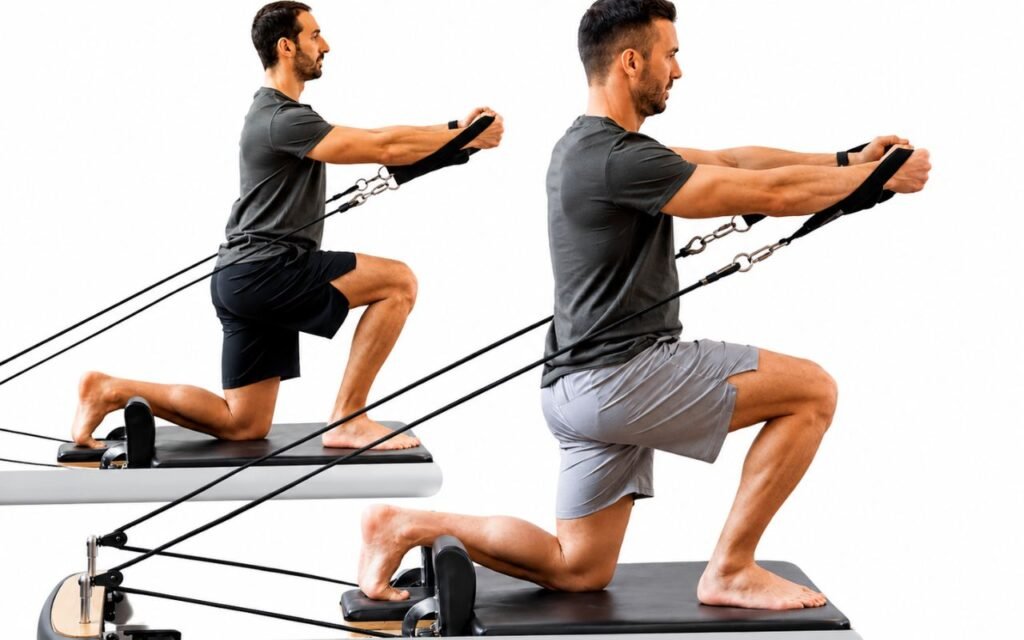
Pilates bar exercises can offer several benefits when performed with good technique. They combine controlled resistance with movements designed to challenge strength, flexibility, stability, and coordination.
They can also be adapted to suit different fitness levels. Beginners can start with lighter resistance and simple movements, while more experienced people can gradually increase resistance or introduce more challenging exercises.
Here are some of the main benefits of adding Pilates bar exercises to your fitness routine.
1. Pilates bar exercises can Increase your flexibility
Flexibility plays an important role in comfortable, efficient movement. Pilates bar exercises can incorporate controlled stretching and mobility movements that work areas such as your hamstrings, hips, shoulders, chest, and back.
The Pilates bar may also provide additional support during certain stretches. This can help you maintain better control while gradually moving through a comfortable range of motion.
For example, leg stretches can target the hamstrings and other lower-body muscles. Upper-body movements can also help improve mobility around the shoulders and chest.
Avoid forcing yourself into uncomfortable positions. Flexibility usually improves gradually, so focus on smooth movement, proper technique, and consistent practice rather than trying to achieve a deep stretch immediately.
2. Pilates bar exercises help you burn calories
Like other forms of physical activity, Pilates bar exercises require energy and therefore burn calories. The exact amount varies depending on your body size, workout duration, resistance level, exercise selection, and intensity.
Full-body exercises that involve several muscle groups can make your workout more demanding. Squats, lunges, presses, and rows can be combined into a routine that challenges both your upper and lower body.
Pilates bar training should not be viewed as a shortcut for fat loss. Weight management depends on your overall activity levels, nutrition, sleep, and long-term consistency.
However, Pilates bar workouts can be a useful part of an active lifestyle and can complement other forms of resistance and cardiovascular training.
3. Improve coordination and strength with Pilates bar exercises
Pilates bar exercises require your muscles to work together while you control the resistance. This combination can help develop both muscular strength and coordination.
Exercises such as squats, lunges, presses, curls, and rows can target different areas of your body. Your core also helps stabilise your torso while your arms and legs move.
Controlled repetitions are particularly important. Rather than using momentum, focus on moving smoothly through each exercise while maintaining good body alignment.
As your technique improves, you can gradually increase the resistance or complexity of your exercises to continue challenging yourself.
4. Improves balance with Pilates bar exercises
Balance relies on coordination between your muscles, joints, nervous system, and core. Certain standing Pilates bar exercises challenge these systems by requiring you to maintain a stable position while moving against resistance.
Your core plays an important role in maintaining stability. When it remains engaged during exercises, it can help you control your torso and maintain better alignment.
Beginners should start with movements that provide a stable base of support. More challenging balance exercises can be introduced gradually as strength and confidence improve.
Good balance is useful beyond your workouts. It contributes to everyday movement and can support better control during many other types of physical activity.
The Best Pilates Bar Exercises That You Can Do at Home
Pilates bar exercises can provide an effective home workout without requiring a large amount of space. You can use different movements to work your upper body, lower body, and core while also incorporating flexibility and mobility exercises.
Before starting, make sure your Pilates bar and resistance bands are properly assembled and secure. Follow the manufacturer’s instructions, particularly when standing on or attaching resistance bands.
Choose a resistance level that allows you to maintain good form throughout every repetition. Quality of movement is more important than simply completing as many repetitions as possible.
Pilates Bar Walking Stretch
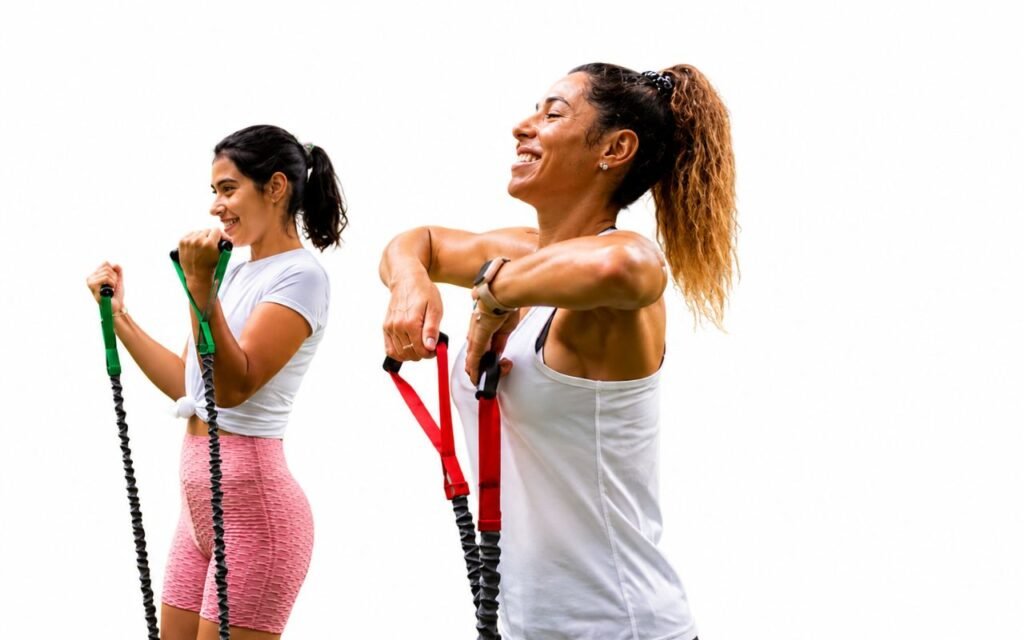
The Pilates Bar Walking Stretch can be used as part of a mobility-focused routine. Begin by standing with your feet around shoulder-width apart while holding the Pilates bar securely with both hands.
Keep your core gently engaged and maintain an upright posture. Move forward in a slow and controlled manner while maintaining a comfortable position through your shoulders and upper body.
Avoid taking excessively long steps or forcing your body into an uncomfortable stretch. The movement should remain smooth and controlled from beginning to end.
This exercise can be incorporated into a warm-up or mobility routine before progressing to more demanding Pilates bar exercises.
Pilates Bar leg stretching
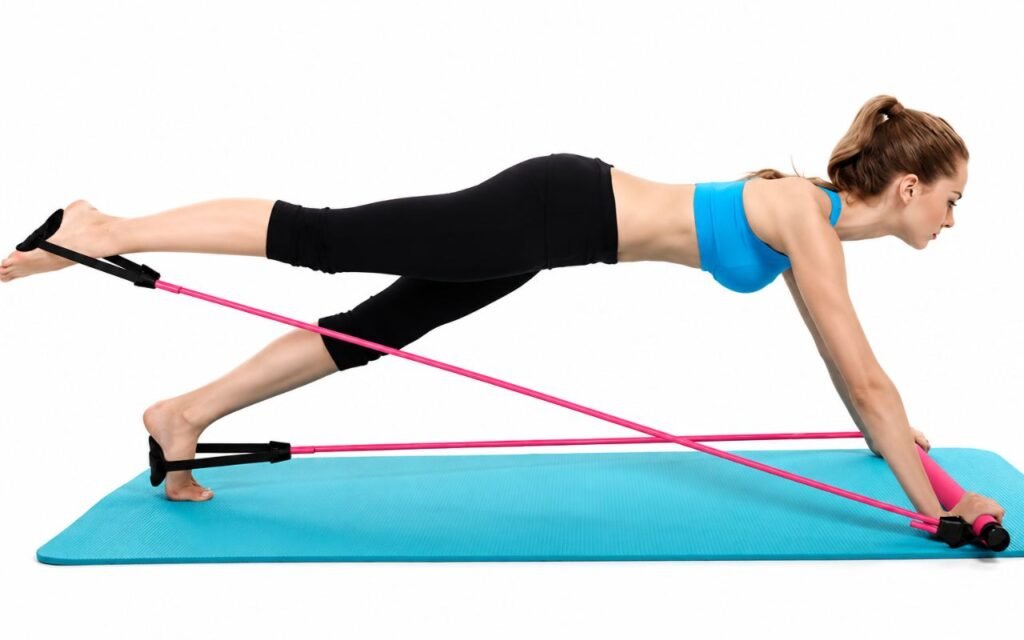
Leg stretching can help maintain flexibility and comfortable movement through your lower body. The Pilates bar may provide support during certain stretches, while resistance bands can be incorporated where appropriate.
There are several areas you may want to target during a lower-body stretching routine.
Hamstring stretches
Hamstring stretches target the muscles along the back of your thighs. Move slowly into the stretch and stop when you feel gentle tension. Avoid bouncing or forcing the movement.
Quadriceps stretches
Quadriceps stretches focus on the large muscles at the front of your thighs. These muscles are heavily involved in movements such as squats, lunges, walking, and running.
Calf stretches
Calf stretches target the muscles at the back of your lower legs. They can be particularly useful as part of a broader lower-body mobility routine.
Piriformis stretches
The piriformis is a small muscle located deep in the buttock region. Gentle stretching around the hips and glutes can form part of a balanced mobility routine.
Your individual flexibility and mobility needs will vary. If you have pain, an existing injury, or limited movement, seek advice from an appropriately qualified health or fitness professional.
Pilates Bar Barbell Exercise
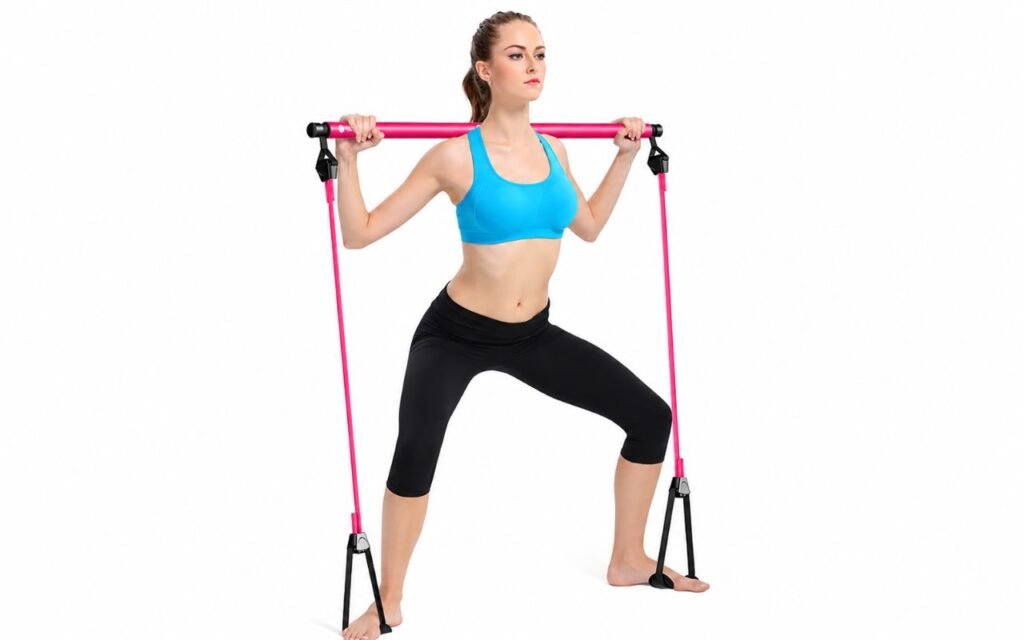
The Pilates Bar Barbell Exercise combines lower-body and upper-body movement to create a more complete exercise.
Begin by standing with your feet around hip-width apart and position your Pilates bar according to the equipment instructions. Brace your core and lower your hips into a controlled squat while keeping your feet firmly planted.
Push through your feet to return to standing. From this position, press the Pilates bar overhead while maintaining a stable torso.
Lower the bar with control before beginning your next repetition. This movement can challenge the quadriceps, glutes, hamstrings, shoulders, arms, and core.
Start with manageable resistance until you are comfortable coordinating both parts of the exercise.
Pilates Bar Waist Twisting
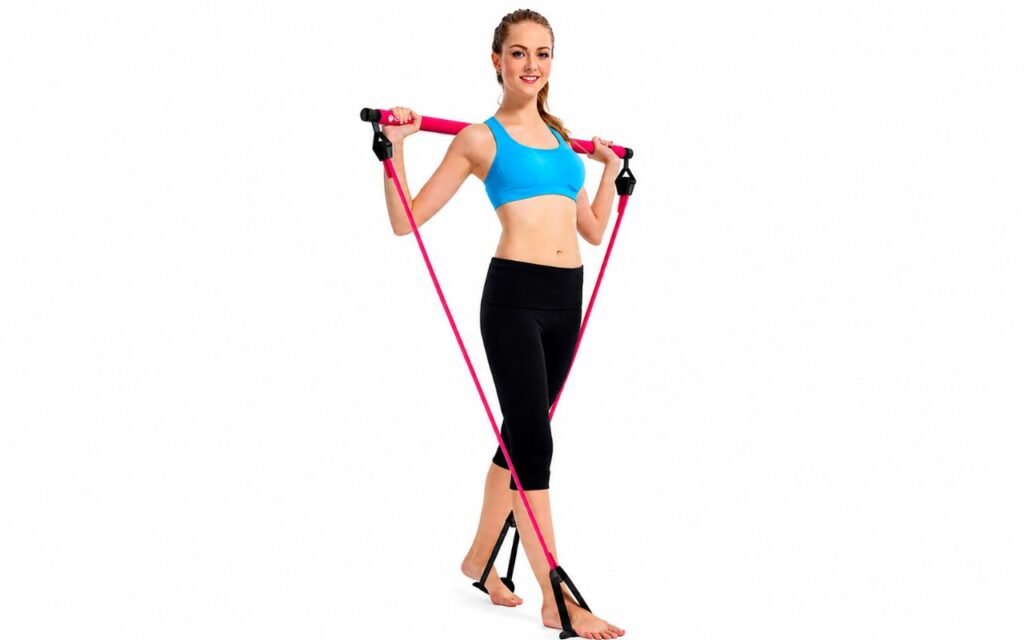
Pilates Bar Waist Twisting focuses on controlled rotation through the torso. Your abdominal and core muscles help stabilise your body as you perform the movement.
Begin in a stable position and hold the Pilates bar securely. Keep your core engaged and rotate your torso gently without forcing the movement through your lower back.
Return to the starting position with control before repeating on the opposite side.
Rotation should remain within a comfortable range of motion. Avoid using momentum or attempting to twist farther than your body comfortably allows.
If you experience back pain or have an existing spinal condition, seek professional advice before introducing rotational exercises.
Pilates Bar Kicks
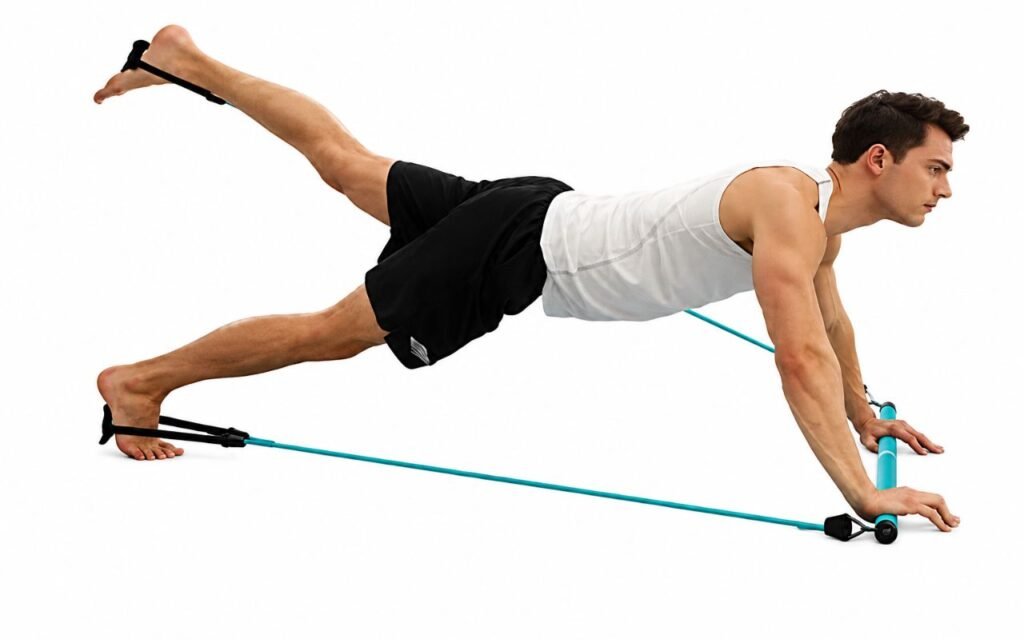
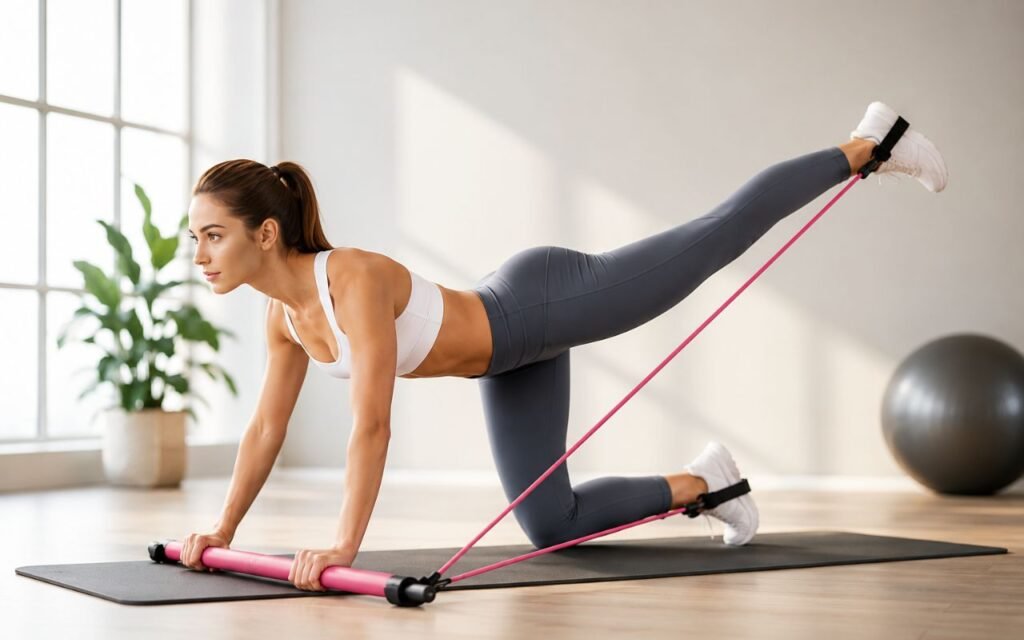
Pilates Bar Kicks can challenge your legs, glutes, core, balance, and coordination. The exact setup will depend on the style of Pilates bar and resistance bands you are using.
Maintain a stable body position and keep your core engaged as you perform each leg movement. Avoid swinging your leg quickly or relying on momentum.
Slow, controlled repetitions generally make it easier to maintain proper alignment while keeping tension on the working muscles.
Beginners should start with a comfortable range of motion and lighter resistance. You can gradually increase the challenge as your balance, strength, and control improve.
Pilates Bar Cycling in the Air
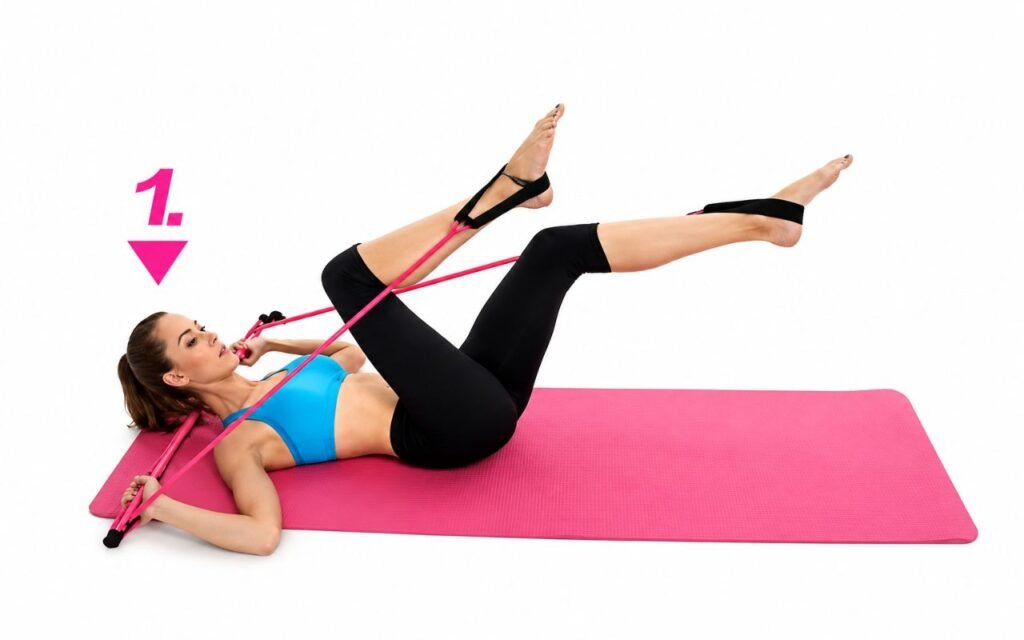
Pilates Bar Cycling in the Air is a more advanced movement that combines lower-body motion with core control. It should only be performed when you can maintain good technique and your equipment is designed for the exercise.
During cycling-style movements, your core works to stabilise your pelvis and torso while your legs move through the cycling pattern.
The goal should be controlled movement rather than speed. If your lower back begins to lift excessively or you lose control of your posture, reduce the range of motion or stop the exercise.
Beginners may benefit from mastering simpler core and leg exercises before attempting more complex movements.
Why do you choose pilates bar exercises?
Pilates bar exercises appeal to many people because they combine resistance, core engagement, flexibility, balance, and controlled movement in one style of training.
1. Holistic Core Strengthening
Many Pilates bar movements require continuous core engagement. Your abdominal, pelvic, hip, and lower-back muscles work together to stabilise your body while your arms and legs move.
2. Adaptability for All Levels
Pilates bar workouts can be modified for different fitness levels. Beginners can use lighter resistance and simpler movements, while experienced exercisers can increase resistance or perform more challenging combinations.
3. Mind-Body Connection
Pilates encourages you to pay attention to breathing, posture, muscle engagement, and movement quality. This focus on body awareness can help you perform exercises more deliberately instead of rushing through repetitions.
4. Versatility and Enjoyment
A Pilates bar can be used for a variety of upper-body, lower-body, core, and mobility exercises. This variety can make workouts more interesting and help prevent your routine from becoming repetitive.
5. Results Beyond the Surface
Fitness is about more than appearance. Regular Pilates bar training can contribute to strength, flexibility, coordination, balance, and overall physical activity.
The most effective exercise routine is one that suits your ability, supports your goals, and can be maintained consistently.
Can You Lose Weight with Pilates Bar Workouts?
Pilates bar workouts can support weight loss when they form part of a balanced exercise and nutrition plan. Like other physical activities, these workouts use energy and can contribute to your overall daily calorie expenditure.
Resistance exercises can also help you maintain and develop muscle while working towards body composition goals. Pilates bar movements often involve several muscle groups, particularly when you combine exercises for the legs, upper body, and core.
However, Pilates alone does not guarantee weight loss. Your results depend on your overall energy balance, nutrition, activity levels, sleep, exercise habits, and consistency.
For many people, a combination of resistance training, cardiovascular activity, regular daily movement, and balanced nutrition provides a more sustainable approach to long-term weight management.
Frequently Asked Questions ( FAQ )
What is a Pilates bar workout?
A Pilates bar workout uses a portable bar, commonly combined with resistance bands, to perform Pilates-inspired and resistance-based exercises. Depending on the movement, you can target your core, legs, glutes, back, shoulders, chest, and arms. The bar can be incorporated into exercises such as squats, rows, presses, curls, leg movements, and controlled stretches. Workout difficulty can be adjusted according to your fitness level and the resistance provided by your equipment.
What is a Pilates bar?
A Pilates bar is a portable exercise bar that is often connected to resistance bands. The bands create resistance while the bar provides a stable grip for performing different upper-body and lower-body movements. A portable Pilates bar should not be confused with a traditional ballet barre. Ballet barres are usually fixed or freestanding supports, while Pilates bars are generally portable resistance-training tools.
Is Pilates bar workout suitable for beginners?
Yes, Pilates bar workouts can be suitable for beginners when exercises and resistance levels are selected appropriately. Start with basic movements and focus on correct technique. Once you can perform the exercises comfortably and with control, you can gradually introduce additional resistance or more challenging variations.
Do I need any special equipment for Pilates bar exercises?
The main equipment is a Pilates bar and its compatible resistance bands. A comfortable exercise mat may also be useful for floor-based movements and stretching. Some workouts may incorporate additional resistance bands or small weights, although these are not necessary for every Pilates bar routine. Always check that your equipment is secure before starting.
Can Pilates bar exercises help with weight loss?
Pilates bar exercises can contribute to a weight management program by increasing physical activity and providing resistance training. For sustainable weight loss, Pilates bar workouts should be considered alongside your overall nutrition, daily activity, cardiovascular exercise, sleep, and lifestyle habits. Consistency across these areas is more important than relying on one particular workout.
Are Pilates bar workouts suitable during pregnancy?
Some Pilates exercises may be modified during pregnancy, but individual circumstances can vary considerably. Speak with your doctor, healthcare professional, or appropriately qualified prenatal exercise professional before starting or continuing a Pilates bar program during pregnancy. They can advise you about suitable movements and any exercises that should be modified or avoided.
How often should I do Pilates bar workouts?
How often you should perform Pilates bar workouts depends on your fitness goals, experience, workout intensity, and other physical activities. For many people, two or three resistance-focused sessions per week can provide a practical starting point. More experienced exercisers may train more frequently when their overall program allows sufficient recovery. Listen to your body and allow appropriate recovery between demanding sessions. Consistent training with good technique is generally more valuable than doing too much too quickly.
Conclusion
Pilates bar exercises offer a versatile way to work on strength, flexibility, balance, coordination, and core stability. They can be performed at home and adapted to different fitness levels, making them a convenient addition to many exercise routines.
The key is to focus on good technique rather than rushing through each movement. Start with manageable resistance, maintain control, and gradually increase the challenge as your strength and confidence improve.
Pilates bar workouts can also complement other forms of exercise. Combining resistance work with cardiovascular activity, mobility training, and adequate recovery can help create a more balanced fitness routine.
If you are unsure how to structure your workouts or perform an exercise correctly, guidance from a qualified fitness professional can help you train more effectively and choose movements suited to your individual goals.