
Chest exercises gym training is one of the most popular goals we see in a commercial gym environment, and for good reason. A strong chest supports pushing strength, upper body balance, posture, and athletic performance. It also plays a major role in everyday movements such as lifting, carrying, and stabilising the shoulders.
At EFM Glenelg, we have spent years coaching members through safe, effective chest training that delivers results without unnecessary strain. This guide is written from that real gym-floor experience. It is designed to help you understand how to train your chest properly, which exercises work best in a gym setting, and how to structure your sessions for long term progress.
Understanding the Chest Muscles and Their Role
Before jumping into exercises, it helps to understand what you are actually training. The chest is made up of several muscles that work together.
The primary chest muscles include the pectoralis major and the pectoralis minor. The pectoralis major is the large muscle responsible for most pressing movements, while the pectoralis minor assists with shoulder stability and movement.
Chest training also heavily involves secondary muscles such as the shoulders and triceps. This is why poor technique or excessive weight often leads to shoulder discomfort rather than chest activation.
From experience, members who understand this connection tend to lift with better control and see more balanced results.
Why Chest Training in a Gym Environment Is Effective
Training chest exercises gym style provides advantages that are hard to replicate at home. Gyms offer a range of equipment, adjustable loads, and safe training environments that allow gradual progression.
Key benefits of gym-based chest training include:
- Access to barbells, dumbbells, cables, and machines
- Safer progression using adjustable resistance
- Better muscle engagement through varied angles
- Structured programs that support consistency
Research published in the Journal of Strength and Conditioning Research shows that resistance training two to three times per week can increase upper body strength by up to 40 percent over 12 weeks when performed correctly.
This reinforces what we see daily on the gym floor. Consistency and smart loading matter more than chasing heavy weights.
Foundational Chest Exercises You Should Master
Not all chest exercises are created equal. Some movements consistently deliver better strength and muscle development, especially when performed with proper technique.
Barbell Bench Press

The barbell bench press is one of the most recognised and widely used chest exercises in the gym. It has remained a cornerstone of strength training for decades because it develops upper body strength efficiently and allows for clear, measurable progression over time.
Across different training styles, the bench press serves multiple purposes. Strength athletes rely on it as one of the primary lifts for assessing pressing power. In athletic settings, bench press strength often correlates with pushing ability and upper body force production. From a muscle-building perspective, it is a compound movement that stimulates a large amount of muscle mass in a single exercise.
The primary muscle targeted during the barbell bench press is the pectoralis major. Supporting muscles include the triceps, front of the shoulders, and stabilising muscles of the upper back. When performed correctly, the chest should do the majority of the work rather than the arms or shoulders.
It is important to note that body structure, mobility, and injury history all influence how well someone tolerates the traditional bench press. For this reason, various grip widths, bench angles, and alternative pressing variations exist to ensure the movement can be trained safely and effectively.
How to Perform the Barbell Bench Press
- Lie flat on the bench with your eyes positioned under the bar
- Place your hands slightly wider than shoulder width on the bar
- Pull your shoulder blades together and press them firmly into the bench
- Plant your feet flat on the floor to create a stable base
- Take a deep breath and unrack the bar while maintaining upper back tension
- Lower the bar slowly by bending the elbows, keeping control throughout
- Bring the bar down toward the lower chest with a straight bar path
- Briefly pause or lightly touch the chest without bouncing
- Press the bar upward by driving through the feet and extending the elbows
- Maintain control until the arms are fully extended
- Repeat for the desired number of repetitions with consistent technique
This approach improves chest activation, reduces unnecessary joint strain, and supports long-term progress in the gym.
Dumbbell Bench Press

The dumbbell bench press is a highly effective chest exercise that allows for greater freedom of movement compared to barbell pressing. Because each arm works independently, this exercise encourages balanced strength development and exposes any left-to-right strength differences that may otherwise go unnoticed.
Across different training populations, dumbbell pressing serves several important roles. For beginners, it helps develop coordination and control through a natural pressing path. For experienced lifters, it provides a valuable way to increase range of motion and challenge stabilising muscles. From a muscle-building perspective, dumbbells allow the chest to work through a deeper stretch, which can enhance overall muscle activation.
The primary muscle targeted during the dumbbell bench press is the pectoralis major. Supporting muscles include the triceps, shoulders, and stabilising muscles of the upper back and core. Many gym members report feeling stronger chest engagement with dumbbells, particularly when shoulder comfort is a priority.
Individual anatomy and mobility play a significant role in how pressing movements feel. Dumbbells offer flexibility in wrist, elbow, and shoulder positioning, making them a suitable option for those who find traditional barbell pressing uncomfortable or restrictive.
How to Perform the Dumbbell Bench Press
- Sit at the end of a flat bench with a dumbbell resting on each thigh
- Lie back carefully while guiding the dumbbells into position above the chest
- Position the dumbbells with palms facing forward or slightly angled inward
- Pull your shoulder blades together and press them into the bench
- Place your feet flat on the floor to create a stable base
- Take a deep breath and brace through the upper body
- Lower the dumbbells slowly by bending the elbows and maintaining control
- Allow the elbows to move slightly below the bench to increase range of motion
- Press the dumbbells upward by driving through the chest and extending the arms
- Keep the movement smooth and controlled throughout
- Bring the dumbbells together at the top without clashing them
- Repeat for the desired number of repetitions with consistent form
Using controlled tempo and proper positioning improves chest activation, enhances joint stability, and supports steady progress over time.
Incline Bench Press

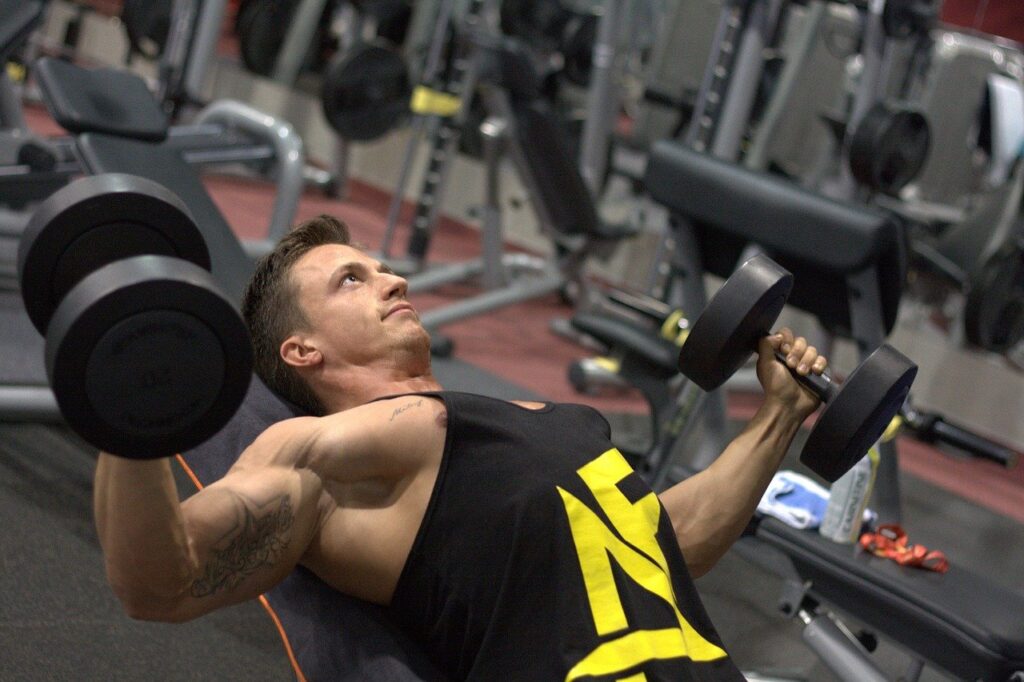
The incline bench press is a valuable chest exercise that places greater emphasis on the upper portion of the chest. This area is often underdeveloped, particularly in gym members who rely heavily on flat pressing movements alone.
By adjusting the bench to an incline, the pressing angle shifts the workload toward the upper chest while still engaging the shoulders and triceps. When performed correctly, this helps create balanced chest development and improves overall upper body aesthetics and strength.
A moderate incline is key to maximising chest involvement. Steeper angles tend to move the load away from the chest and place unnecessary stress on the shoulders. In our experience, smaller adjustments in bench angle often produce better muscle activation and improved comfort.
The incline bench press can be performed using either a barbell or dumbbells, depending on training goals and individual shoulder tolerance. Both variations are effective when technique, control, and appropriate load selection are prioritised.
How to Perform the Incline Bench Press
- Adjust the bench to a moderate incline, typically between 15 and 30 degrees
- Sit back on the bench with your feet firmly planted on the floor
- Grip the bar or dumbbells just outside shoulder width
- Pull your shoulder blades together and press them into the bench
- Unrack the weight with control while maintaining upper back tension
- Lower the weight slowly toward the upper chest
- Keep elbows slightly tucked to maintain shoulder comfort
- Lightly touch the chest or reach a controlled bottom position
- Press the weight upward by driving through the chest and extending the arms
- Maintain a steady tempo throughout the movement
- Repeat for the desired number of repetitions with consistent technique
Using a controlled incline and proper setup helps target the upper chest effectively while reducing unnecessary strain on the shoulders.
Isolation Chest Exercises That Improve Shape and Control
Compound lifts build strength, but isolation exercises refine muscle control and improve overall chest development.
Cable Chest Flyes

Cable chest flyes are an effective isolation exercise that keeps constant tension on the chest muscles from start to finish. Unlike free weights, cables maintain resistance through the entire range of motion, making them especially useful for controlled muscle engagement and targeted hypertrophy.
This exercise allows the chest to work without relying heavily on momentum or supporting muscles. As a result, cable flyes are often used to reinforce proper chest activation, particularly after compound pressing movements.
From real-world coaching experience, better results come from using lighter loads and focusing on movement quality. Slow, controlled repetitions allow the chest muscles to stay under tension longer, while excessive weight often leads to swinging and reduced effectiveness.
Cable flyes can be performed from different angles to target various areas of the chest. Regardless of variation, control and intent remain the key factors for safe and productive training.
How to Perform Cable Chest Flyes
- Set the cable handles at chest height or slightly above
- Stand in a staggered stance to improve balance and control
- Grip the handles with a neutral or slightly pronated hand position
- Pull your shoulder blades gently back and down
- Begin with arms open and a slight bend in the elbows
- Bring the handles together in front of the chest with controlled movement
- Focus on squeezing the chest muscles at the end of the range
- Slowly return to the starting position without letting the weights pull you back
- Maintain steady tension throughout each repetition
- Repeat for the desired number of repetitions using smooth, controlled tempo
When performed with intention and control, cable chest flyes are a reliable tool for improving chest definition and muscular control in the gym.
Pec Deck Machine

The pec deck machine is a practical chest exercise that suits both beginners and experienced gym members. It provides a fixed movement path, which allows for controlled chest activation without requiring a high level of technical skill or coordination.
Because the machine supports body position and limits unnecessary movement, it is especially effective for isolating the chest muscles. This makes it a useful option for reinforcing proper muscle engagement, particularly for those still developing pressing mechanics or managing joint sensitivity.
The pec deck is commonly used toward the end of a chest workout when fatigue starts to affect stability and control. At this stage, the machine helps maintain consistent tension on the chest while reducing the need for balance or complex movement patterns.
When performed with a controlled tempo and appropriate resistance, the pec deck machine allows the chest muscles to work efficiently while minimising strain on the shoulders and elbows.
How to Perform the Pec Deck Machine
- Adjust the seat height so the handles align with the mid-chest
- Sit upright with your back pressed firmly against the pad
- Place your forearms or hands on the machine handles as designed
- Keep your chest tall and shoulders relaxed
- Begin with arms open and elbows slightly bent
- Bring the handles together in front of the chest with controlled movement
- Focus on squeezing the chest muscles at the midpoint
- Slowly return to the starting position without letting the weight slam
- Maintain steady tension throughout each repetition
- Repeat for the desired number of repetitions using smooth control
Used correctly, the pec deck machine is an effective way to finish a chest session with focused muscle engagement and minimal technical demand.
Comparing Common Chest Exercises in the Gym
The table below highlights how different chest exercises perform across key training factors.
| Exercise Type | Strength Potential | Muscle Activation | Skill Level | Joint Stress |
|---|---|---|---|---|
| Barbell Bench Press | High | Moderate | Advanced | Moderate |
| Dumbbell Bench Press | Moderate to High | High | Intermediate | Low to Moderate |
| Incline Press | Moderate | Upper Chest Focus | Intermediate | Moderate |
| Cable Flyes | Low | High | Beginner Friendly | Low |
| Pec Deck | Low | Moderate | Beginner Friendly | Low |
This comparison reflects real-world observations across group personal training sessions and individual programs.
How Often Should You Train Chest
Frequency matters just as much as exercise choice. Training chest too often limits recovery, while training too rarely slows progress.
For most gym members, the following approach works well:
- Two chest focused sessions per week
- At least 48 hours between sessions
- 9 to 15 total working sets per week
A 2021 review in Sports Medicine found that moderate volume split across multiple sessions led to better muscle growth than one high-volume session.
This aligns with how we program chest training at EFM Glenelg.
Sample Chest Workout Structure for the Gym
Here is a simple structure that balances strength and muscle development.
- Barbell or dumbbell bench press
3 to 4 sets of 6 to 8 reps - Incline dumbbell press
3 sets of 8 to 10 reps - Cable chest flyes
3 sets of 12 to 15 reps - Pec deck or push-up variation
2 to 3 sets to controlled fatigue
Rest periods should range between 60 and 120 seconds depending on the exercise and load.
Common Mistakes We See with Chest Exercises
Many gym members struggle with chest development due to avoidable mistakes.
The most common issues include:
- Lifting too heavy at the expense of technique
- Overusing shoulders and arms
- Skipping warm-up sets
- Training chest every session without recovery
From experience, correcting technique alone often leads to visible improvements within weeks.
Injury Prevention and Shoulder Health
Healthy shoulders are essential for long-term chest training. Poor shoulder mobility or weak stabilisers often limit chest progress.
Practical strategies include:
- Warm-up sets with lighter weight
- Scapular stability exercises
- Balanced pulling exercises such as rows
- Avoiding excessive volume when fatigued
According to the British Journal of Sports Medicine, balanced push and pull training reduces shoulder injury risk by up to 30 percent.
Real Gym Floor Insight from Trainers
One consistent observation across years of coaching is that members who slow down their reps feel their chest working more effectively.
Tempo control, especially on the lowering phase, improves muscle engagement and reduces joint strain. This approach benefits beginners and advanced lifters alike.
Chest Training for Beginners Versus Advanced Members
Beginners should prioritise learning movement patterns and building tolerance. Machines and dumbbells often work better early on.
Advanced members benefit from:
- Heavier compound lifts
- Varied angles and tempos
- Progressive overload tracking
Both groups see the best results when training is structured rather than random.
Continue Learning and Training Smarter
Chest training works best when it is part of a balanced, well-structured program. If you want to deepen your understanding, explore our related content on strength training fundamentals, group personal training benefits, and injury prevention strategies.
At EFM Glenelg, we see the best results when members train with purpose, consistency, and expert guidance. Chest exercises done properly build more than muscle. They build confidence, resilience, and long-term strength.
Frequently Asked Questions
How often should I do chest exercises gym sessions each week
Most people benefit from two structured chest sessions per week with adequate recovery between workouts.
Are machines or free weights better for chest training
Both have value. Free weights improve coordination and strength, while machines offer controlled muscle activation.
Can beginners safely train chest in a gym
Yes, when exercises are selected appropriately and technique is prioritised over heavy weight.
How long does it take to see chest muscle results
Visible strength and muscle changes often appear within 6 to 8 weeks when training and nutrition are consistent.
Should chest exercises gym workouts cause shoulder pain
No. Shoulder discomfort usually indicates poor technique, excessive load, or inadequate mobility work.
Final Thoughts
Chest training is far more than chasing a bigger bench press or aesthetic results. When programmed and performed correctly, chest exercises support overall upper body strength, shoulder stability, and long-term training sustainability. The most consistent progress we see in a gym environment comes from members who focus on technique, appropriate load selection, and structured progression rather than intensity alone.
Effective chest training balances compound lifts with isolation work, respects recovery time, and adapts to individual ability levels. Small adjustments such as slowing down reps, improving setup, or choosing the right exercise variation often make a noticeable difference within weeks. Just as important is understanding that chest development is influenced by the shoulders, triceps, and upper back, making balanced training essential.
Whether you are new to the gym or have years of experience, approaching chest training with intention and patience leads to stronger, safer, and more sustainable results over time.