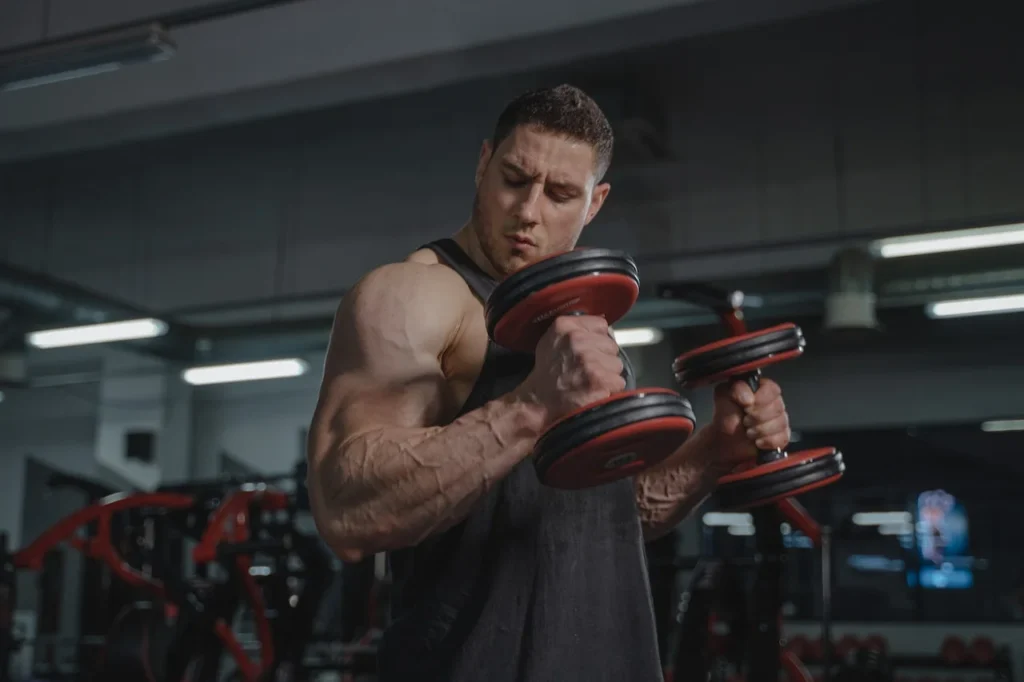
If your goal is to build bigger, stronger arms, your biceps training should include more than one type of curl. The biceps brachii has two heads, known as the long head and short head, and both contribute to elbow flexion and forearm supination.
The long head sits along the outer portion of the upper arm and contributes to the overall shape of the biceps. This is why long head bicep exercises are often included in programs focused on improving arm size and the appearance of the biceps peak.
However, no exercise completely isolates one head of the biceps. Shoulder position, grip and resistance profile can change how the muscle is challenged, but both heads continue to contribute.
At EFM Glenelg, we recommend combining different curl variations with compound pulling exercises and progressive resistance rather than relying on one so-called perfect biceps exercise.
What Is the Long Head of the Biceps?
The biceps brachii consists of a long head and a short head. Both cross the elbow and contribute to bending the arm, while the biceps also plays an important role in rotating the forearm into a palm-up position.
The long head originates near the shoulder and runs along the outer side of the upper arm before joining the rest of the biceps.
Because it crosses both the shoulder and elbow joints, changing shoulder position can alter muscle length and the way the biceps is loaded during curls.
Research comparing incline dumbbell curls, preacher curls and standard curls has shown that shoulder position can change the activation pattern of the biceps brachii long head during different phases of the exercise.
This does not mean one movement completely isolates the long head.
Instead, using several curl positions can provide different training stimuli and contribute to more complete biceps development.
Can You Really Target the Long Head of the Biceps?
You can emphasise the long head in different ways, but you cannot switch off the short head completely.
Fitness advice sometimes suggests that one grip or exercise will exclusively build the biceps peak. Human anatomy is more complicated than that.
Shoulder position can influence muscle length and how torque is distributed during curls. Research has found different long-head activation patterns between incline, preacher and standing dumbbell curls.
More recent evidence also suggests that different curl positions may produce regional differences in biceps growth, although the overall hypertrophy response can be similar between exercises when resistance profiles are appropriately matched.
The practical takeaway is simple.
Do not spend your entire arm workout searching for one perfect long-head exercise. Use a combination of curls performed from different shoulder positions, then progressively improve your strength and training volume over time.
7 Long Head Bicep Exercises at a Glance
These exercises provide a useful mix of compound pulling movements and direct biceps training.
| Exercise | Main Focus | Equipment | Suggested Reps |
|---|---|---|---|
| Chin-ups | Biceps, lats, upper back | Pull-up bar | 5 to 10 |
| Drag curls | Biceps | Barbell or EZ-bar | 8 to 12 |
| Hammer curls | Biceps, brachialis, brachioradialis | Dumbbells | 8 to 12 |
| Incline dumbbell curls | Biceps in lengthened position | Dumbbells and bench | 8 to 12 |
| Close-grip EZ-bar curls | Biceps | EZ-bar | 8 to 12 |
| Bayesian cable curls | Biceps with arm behind torso | Cable machine | 10 to 15 |
| Supinating dumbbell curls | Biceps and forearm supination | Dumbbells | 8 to 12 |
These repetition ranges are practical starting points rather than strict rules.
The resistance should become challenging while still allowing you to control each repetition.
1. Chin-Ups
Chin-ups are a compound pulling exercise that train the biceps along with the lats, upper back, forearms and grip.
Use an underhand grip with your palms facing towards you. Begin from a controlled hanging position and pull yourself upwards by driving your elbows towards your sides.
Avoid swinging your body or using excessive momentum.
Lower yourself slowly before beginning the next repetition.
If you cannot complete a full chin-up yet, use an assisted pull-up machine, resistance band or lat pulldown variation while building strength.
Chin-ups are useful because they allow the biceps to work against relatively high resistance while also training several large upper-body muscles.
However, they are not purely a long-head biceps exercise.
We generally use chin-ups as one of the compound movements in an upper-body or pull workout before moving to more direct curls.
Once bodyweight repetitions become manageable, progression can come from additional repetitions or carefully added resistance.
2. Drag Curls
Drag curls are a useful biceps variation where the elbows travel backwards as the bar moves up the body.
Stand holding a barbell or EZ-bar with an underhand grip.
Instead of curling the bar in a wide arc away from your body, pull your elbows backwards while allowing the bar to travel close to your torso.
Curl until you reach a comfortable contraction, then lower the bar under control.
Because the shoulder moves into extension during the exercise, the movement changes the position of the biceps compared with a conventional standing curl.
Use less weight than you might use for a standard barbell curl.
The purpose is not to drag the heaviest possible bar up your body. It is to maintain a controlled elbow-flexion movement while keeping the resistance close.
At EFM Glenelg, we would generally treat drag curls as an accessory exercise rather than the main strength movement of an arm session.
They can add useful variety alongside incline curls and standard curls.
3. Dumbbell Hammer Curls
Hammer curls are an excellent arm exercise, although they are not specifically a long-head isolation movement.
They use a neutral grip with your palms facing each other and place substantial demand on the brachialis and brachioradialis as well as the biceps.
Those muscles contribute to overall upper-arm and forearm development, which can make the arms look thicker.
Stand tall with a dumbbell in each hand.
Keep your elbows relatively close to your sides and curl the weights upwards without rotating your palms.
Lower them under control.
Research comparing different grip positions during biceps curls shows that hand position changes the relative muscle excitation of the biceps and brachioradialis.
This makes hammer curls useful within a balanced arm program.
Do not swing your torso to move heavier dumbbells.
If you cannot keep your upper arm reasonably stable, reduce the weight and make the repetitions more controlled.
4. Incline Dumbbell Curls
Incline dumbbell curls are one of the most useful long head bicep exercises because the arms begin slightly behind the torso, placing the biceps in a relatively lengthened position.
Set an adjustable bench to a comfortable incline and sit back with a dumbbell in each hand.
Allow your arms to hang naturally towards the floor.
Keeping your upper arms relatively stable, curl the dumbbells upwards while rotating your palms towards you if needed.
Lower the weights slowly until your elbows are nearly straight.
Do not allow your shoulders to roll forward to shorten the range.
Research comparing different curl positions found that incline curls create a different activation pattern in the biceps long head compared with preacher and standing curls.
A 2025 study also reported regional differences in muscle growth between incline and preacher curl training.
Use moderate resistance and prioritise the lengthened position rather than chasing heavy dumbbells.
5. Close-Grip EZ-Bar Curls
Close-grip curls are a simple way to add direct biceps work to your program.
An EZ-bar can be particularly comfortable because its angled handles may reduce wrist strain compared with a straight bar for some people.
Stand holding the bar with an underhand grip that is slightly narrower than shoulder width.
Keep your torso stable and curl the bar upwards by bending your elbows.
Avoid letting the elbows travel dramatically forward during every repetition.
Lower the bar slowly until your arms are almost straight.
A narrow grip is often promoted as a way to target the long head, but the effect should not be exaggerated.
Both biceps heads continue to contribute, and grip width alone will not determine your final arm shape.
Choose the grip that allows strong, comfortable repetitions.
At EFM Glenelg, we are more interested in whether you can progressively improve the exercise over time than whether your hands are positioned a few centimetres narrower or wider.
6. Bayesian Cable Curls
Bayesian cable curls place the working arm behind the torso, creating a lengthened position for the biceps while maintaining cable resistance throughout the movement.
Stand facing away from a low cable pulley and hold the handle in one hand.
Take a small step forward so your arm begins slightly behind your body.
Keep your shoulder relatively stable and curl the handle towards you by bending your elbow.
Slowly return to the starting position without allowing the cable to pull your shoulder backwards uncontrollably.
This exercise has received increasing research attention.
A 2025 study comparing Bayesian cable curls with preacher curls found similar overall muscle hypertrophy and strength improvements when resistance profiles were matched appropriately.
That is an important reminder that a lengthened position is useful but not magical.
Bayesian curls can provide excellent variation, particularly if you enjoy cable training, but they should be one part of a broader biceps program.
7. Supinating Dumbbell Curls
Supinating dumbbell curls train two important functions of the biceps at the same time.
The elbow bends while the forearm rotates into a palm-up position.
Begin standing or seated with a dumbbell in each hand.
Your palms can start facing your sides. As you curl the dumbbell upwards, gradually rotate the forearm so your palm faces towards your shoulder.
Reverse the movement during the lowering phase.
Do not rotate only at the wrist. The rotation should come through the forearm.
Using dumbbells allows each arm to work independently, which can also make left-to-right differences easier to notice.
This is a useful general biceps exercise rather than an exclusive long-head movement.
Research shows that forearm position changes muscle excitation during curls, which supports using more than one grip style across a training program.
For most people, controlled repetitions with a full comfortable range will provide more value than excessively heavy curls.
Long Head Bicep Exercises Compared
Different exercises challenge the biceps from different shoulder positions and resistance profiles.
| Exercise | Shoulder Position | Main Advantage |
| Incline curl | Arm behind torso | Challenges biceps at longer muscle length |
| Bayesian curl | Arm behind torso | Cable resistance through the movement |
| Drag curl | Shoulder moves backwards | Different curl path |
| Close-grip curl | Arm beside torso | Easy progressive loading |
| Chin-up | Arm starts overhead | Heavy compound pulling |
| Hammer curl | Arm beside torso | Adds brachialis and forearm emphasis |
| Supinating curl | Arm beside torso | Trains elbow flexion and supination |
There is no need to choose only one.
A complete biceps program can include a curl with the arm behind the body, one with the arm beside the torso and perhaps a compound pulling exercise.
This gives your elbows and shoulders several movement positions while making the program more varied.
What Exercise Is Best for the Bicep Peak?
The appearance of your biceps peak is influenced partly by muscle size and partly by your individual anatomy and muscle-tendon structure.
You cannot completely change your genetic muscle shape through a specific curl.
What you can do is increase the overall size and strength of the biceps.
Training the long head may contribute to fuller development of the outer biceps, but claims that one exercise will create a dramatically higher peak should be treated cautiously.
Research comparing curl variations supports using different shoulder positions, but it does not establish one universal exercise as the only movement needed for long-head growth.
If arm size is your goal, focus on building both biceps heads as well as the brachialis and triceps.
Remember that the triceps make up a substantial portion of your upper-arm musculature.
A complete arm program should therefore include both pulling and pressing or elbow-extension exercises rather than biceps curls alone.
How to Structure a Long Head Bicep Workout
You do not need seven different biceps exercises in one session.
For most gym members, two or three direct biceps exercises can provide plenty of stimulus when they are combined with rows, pull-ups and other pulling movements.
A simple workout could look like this:
- Chin-ups for 3 sets of 5 to 8 repetitions
- Incline dumbbell curls for 3 sets of 8 to 12 repetitions
- Hammer curls for 2 to 3 sets of 10 to 12 repetitions
- Bayesian cable curls for 2 sets of 12 to 15 repetitions
This gives you compound pulling, lengthened-position curls and neutral-grip arm work.
ACSM’s 2026 resistance-training guidance indicates that muscle growth is supported by sufficient weekly training volume and consistent resistance training, with around 10 weekly sets per muscle group providing a useful general target for hypertrophy in many healthy adults.
Your rows and pull-ups also contribute to biceps workload.
How Many Sets and Reps Should You Do?
For muscle growth, you can build biceps across several repetition ranges.
Moderate ranges such as 8 to 12 repetitions are particularly practical because they allow meaningful resistance without making every set extremely heavy.
Smaller cable and dumbbell exercises can also work well in ranges of 10 to 15 repetitions.
For chin-ups or heavier curls, you may sometimes use lower repetition ranges.
A simple starting approach is:
- 2 to 4 working sets per exercise
- 6 to 12 repetitions for heavier movements
- 10 to 15 repetitions for lighter accessory curls
- Controlled lowering on every repetition
- Enough recovery to maintain technique
ACSM’s updated resistance-training position stand reviewed 137 studies and data involving more than 30,000 participants. It emphasises consistent resistance training over unnecessarily complicated programming.
You do not need to take every set to complete failure.
Train hard, maintain control and gradually improve your performance.
Progressive Overload for Bigger Biceps
If you perform the same weight for the same number of repetitions forever, progress will eventually slow.
Progressive overload means gradually increasing the challenge.
You can add weight, perform more repetitions, increase the number of sets or improve the quality and range of the movement.
For example, suppose you perform incline dumbbell curls for three sets of eight repetitions.
Over several weeks, you might progress towards three sets of 10 or 12.
Once you can complete those repetitions comfortably with good technique, move to slightly heavier dumbbells and build up again.
Do not increase resistance so quickly that your curl becomes a full-body movement.
At EFM Glenelg, we encourage members to track their training.
Write down the weight, sets and repetitions you perform.
Small improvements may not look dramatic from one session to the next, but consistent progression across three to six months can create a significant difference in strength and muscle development.
Should You Train Biceps at Long Muscle Lengths?
Training muscles in relatively lengthened positions has become an important area of resistance-training research.
For biceps, exercises such as incline curls and Bayesian curls place the upper arm behind the torso and can create a longer starting position.
However, current evidence does not support treating this as the only effective way to grow biceps.
A 2025 trial comparing preacher and Bayesian cable curls found equivalent overall hypertrophy and strength gains when resistance profiles were appropriately matched.
Another 2025 study comparing incline and preacher curls found regional differences in growth, suggesting exercise position may influence where adaptations occur within the elbow flexors.
This is why variety can be useful.
Include at least one exercise that challenges your biceps at a longer muscle length, but do not abandon preacher curls, standing curls or other movements that you can progressively train effectively.
Common Biceps Training Mistakes
One of the most common mistakes in biceps training is choosing a weight that is too heavy to curl properly.
As the resistance increases, people often begin swinging the torso, lifting the elbows or shortening the range of motion.
That may allow a heavier dumbbell to move, but it changes the exercise.
Other common mistakes include:
- Performing too many curl variations in one session
- Training biceps heavily every day
- Using momentum instead of elbow flexion
- Ignoring the lowering phase
- Changing exercises every week
- Neglecting compound pulling exercises
- Assuming a narrow grip completely isolates the long head
- Expecting one exercise to change genetic muscle shape
- Training through persistent elbow or shoulder pain
Better biceps training is usually simpler.
Select a few exercises you can perform comfortably, keep them in your program long enough to measure improvement and progressively increase the challenge.
Consistency will matter far more than constantly searching for a new curl variation.
How Often Should You Train Your Biceps?
For many gym members, training the biceps around twice per week can provide a practical starting point.
You do not necessarily need separate arm days.
Your biceps already work during pull-ups, pulldowns and rows, which means direct curls should be considered alongside your total pulling volume.
For example, you might perform several back exercises followed by two curl variations on Monday and repeat a smaller amount of biceps work later in the week.
This distributes your training volume rather than performing all your sets in one session.
ACSM’s current guidance recommends training all major muscle groups at least twice weekly for healthy adults.
Recovery still matters.
If your elbows remain sore or your performance continually declines, more biceps training may not be the solution.
Use enough volume to create progress while leaving yourself capable of recovering before your next demanding session.
Biceps Exercises for Beginners
Beginners do not need specialised long-head training immediately.
Start by learning basic pulling and curling movements.
Lat pulldowns, assisted chin-ups, dumbbell curls and hammer curls can provide a simple introduction.
Once you can perform those exercises comfortably, incline curls or cable variations can add more variety.
A beginner arm workout could include:
- Lat pulldowns
- Dumbbell curls
- Hammer curls
That is enough to start developing pulling strength and learning elbow-flexion exercises.
We often see beginners become distracted by advanced techniques before they have built a strong foundation.
At EFM Glenelg, we prefer to teach movement first and progression second.
You do not need drop sets, forced repetitions or complicated curl combinations when you are just starting.
Learn to control the weight through a full comfortable range, then gradually increase resistance as you become stronger.
Simple training performed consistently can produce excellent progress.
Long Head Biceps vs Short Head Biceps
Both heads of the biceps contribute during curls, but their anatomical positions differ.
The long head runs along the outer portion of the upper arm, while the short head lies more towards the inner side.
You cannot fully isolate either one.
However, changing your shoulder position, grip and resistance profile can alter how the biceps are challenged.
This is why a balanced biceps routine may contain several movement types rather than performing only one curl.
For example, you could combine incline dumbbell curls with preacher curls and hammer curls.
Current research suggests that different curl positions can produce regional differences in muscle development, supporting the idea of using complementary exercises rather than assuming one variation does everything.
Your overall arm development also depends on more than the biceps.
Train your triceps, shoulders and forearms as part of a complete upper-body program if your goal is bigger and stronger arms.
Final Thoughts
Long head bicep exercises can be a useful part of an arm-building program, particularly when you combine different shoulder positions and resistance profiles.
Incline dumbbell curls, Bayesian cable curls, drag curls, chin-ups and other variations can all contribute to biceps development.
However, no exercise completely isolates the long head or guarantees a dramatically higher biceps peak. Your genetics influence muscle shape, while training determines how much muscle and strength you can develop.
Current research suggests that different curl positions can change activation and regional growth patterns, but several exercises remain effective when trained consistently.
At EFM Glenelg, we recommend keeping arm training practical. Choose a few exercises, learn the technique and progressively improve your sets, repetitions or resistance.
If you want bigger arms, do not chase endless curl variations. Build stronger biceps, train your triceps as well, recover properly and give the process enough time to work.