Pregnancy can change the way your body feels and moves from one week to the next. As your centre of gravity shifts and your body adapts, comfortable forms of movement can become particularly valuable.
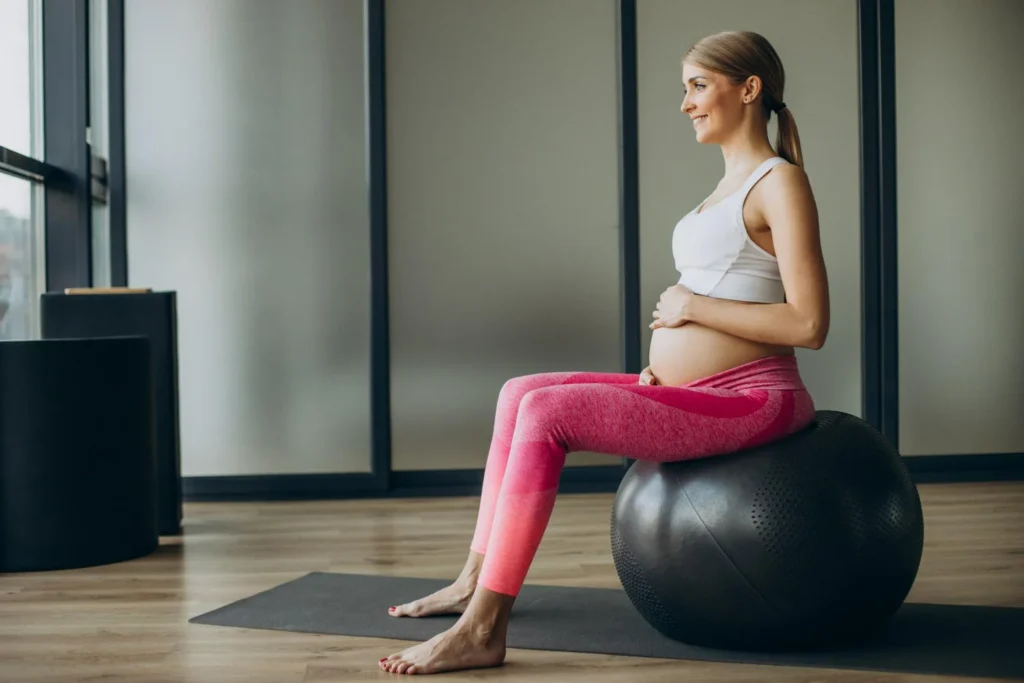
Pregnancy ball exercises can provide one option for staying active. A large stability or birthing ball can be used for supported sitting, gentle pelvic movement and selected strength exercises when they are appropriate for the individual.
Australian Government guidance encourages healthy pregnant women to remain physically active on most, preferably all, days. It recommends a weekly total of 2.5 to 5 hours of moderate activity or an equivalent combination of moderate and vigorous exercise, along with muscle-strengthening activity at least twice per week.
At EFM Glenelg, we believe pregnancy exercise should always be individual. Before introducing new exercises, particularly if you have pregnancy complications, speak with your doctor, midwife or appropriately qualified health professional.
Are Pregnancy Ball Exercises Safe?
For many people with a healthy, uncomplicated pregnancy, physical activity can be continued or introduced with appropriate modifications. Australian Government guidelines state that being active during pregnancy provides health benefits, but exercises may need to change as pregnancy progresses.
A pregnancy ball does not automatically make an exercise safe.
Ball size, stability, your balance, pregnancy stage and exercise experience all matter. The ball should be properly inflated and positioned on a non-slip surface with enough space around you.
If you feel unstable, perform the exercise next to a wall or another secure support.
Pregnant people with complications should obtain professional advice before starting, continuing or returning to physical activity. Australian guidance also recommends speaking with a doctor about the type of activity that is most appropriate for you.
The aim is comfortable movement, not pushing through pain or instability.
Benefits of Exercise During Pregnancy
Regular physical activity during a healthy pregnancy can support both physical and mental wellbeing.
Australian Government guidance identifies several potential benefits, including less back and pelvic pain, lower risk of gestational diabetes, better mental health and preparation for labour and recovery.
Pregnancy Birth and Baby also advises that regular activity can be beneficial when exercise is performed at a safe and appropriate level.
An exercise ball can simply provide another way to move.
It may allow you to perform gentle seated movement, supported squatting and light strengthening while adjusting the exercise according to comfort.
However, you do not need a pregnancy ball to receive the benefits of physical activity.
Walking, stationary cycling, swimming and light resistance training are also listed by the Australian Government as suitable examples of activity during pregnancy.
Choose movement that suits your body and medical circumstances.
Pregnancy Ball Exercises at a Glance
These exercises are intended as general examples for people who have been cleared to exercise. They are not a substitute for individual medical or physiotherapy advice.
| Exercise | Main Focus | General Approach |
|---|---|---|
| Seated pelvic tilts | Pelvic and trunk control | Slow controlled movement |
| Seated hip circles | Comfortable pelvic mobility | Small circles |
| Ball marching | Balance and trunk control | Alternate feet slowly |
| Supported wall squat | Legs and glutes | Comfortable squat depth |
| Seated knee extensions | Thigh strength | Alternate legs |
| Seated heel raises | Calves and lower-leg movement | Controlled repetitions |
| Pelvic floor exercise on ball | Pelvic floor awareness | Gentle squeeze and release |
Your range of motion may change throughout pregnancy.
An exercise that feels comfortable during one trimester may need to be modified later, so treat comfort and stability as your guide rather than trying to reach a fixed number of repetitions.
1. Seated Pelvic Tilts
Seated pelvic tilts are a simple way to introduce gentle movement while sitting on a pregnancy ball.
Sit near the centre of the ball with both feet flat on the floor and positioned wide enough to feel stable. Keep your upper body relaxed.
Slowly tilt your pelvis forwards and backwards through a small, comfortable range.
The movement should remain controlled. You do not need to exaggerate the arch or rounding of your lower back.
Start with approximately 8 to 12 slow repetitions if comfortable.
This movement is about awareness and mobility rather than intensity.
If sitting on the ball makes you feel unstable or dizzy, use a stable chair instead.
Pregnancy changes your centre of gravity, and Australian guidance notes that exercises may need modification as your body changes.
Keep the ball somewhere it cannot slide and use nearby support when needed.
2. Seated Hip Circles
Hip circles are another gentle movement you can perform while sitting on a stability ball.
Begin with your feet firmly planted and your torso upright.
Slowly move your pelvis in a small circular pattern. Complete several circles in one direction before changing direction.
The movement does not need to be large.
Aim for smooth, controlled motion while keeping enough pressure through your feet to remain stable.
Some people find pelvic circles comfortable as pregnancy progresses, but they should not be promoted as a guaranteed way to induce labour or change the baby’s position.
Their role here is simply gentle movement.
If you have pelvic girdle pain or another condition that makes the movement uncomfortable, stop rather than trying to work through it.
Pregnancy Birth and Baby advises stopping any exercise that causes or worsens pregnancy-related back pain and discussing exercise with your healthcare provider.
3. Seated Ball March
A seated march adds a small balance challenge while keeping you supported on the ball.
Sit upright with your feet flat and slightly wider than hip width.
Once you feel stable, slowly lift one foot a small distance from the floor. Place it back down before lifting the opposite foot.
The goal is not to lift your knee as high as possible.
Try to maintain a steady torso and avoid shifting dramatically from side to side.
Beginners can keep one hand against a wall or stable support.
Start with a few alternating repetitions and increase only if the movement remains comfortable.
Because balance can change during pregnancy, this exercise will not suit everyone.
Australian guidance specifically recommends avoiding activities with a high risk of falling.
If you cannot perform the march confidently on the ball, do the same movement from a stable chair instead.
Safety is more important than making the exercise challenging.
4. Supported Wall Squats With a Ball
A stability ball can provide support between your back and a wall while performing a shallow squat.
Place the ball between your mid-to-lower back and a solid wall. Step your feet forward enough that you can bend your knees without losing balance.
Slowly bend your knees and allow the ball to roll with you.
Only descend as far as feels comfortable.
Then press through your feet to return to standing.
There is no need to hold dumbbells as described in some pregnancy workout routines. Bodyweight alone may provide enough resistance, particularly as pregnancy progresses.
Australian Government guidance recommends light resistance or bodyweight strengthening activities during pregnancy while advising against heavy lifting.
Start with a small number of controlled repetitions.
Stop if you experience pelvic pain, dizziness or discomfort.
If squatting has not previously been part of your exercise routine, professional instruction can help determine an appropriate stance and range of motion.
5. Seated Knee Extensions
Seated knee extensions provide a simple way to move and strengthen the legs while remaining upright.
Sit securely on the ball with both feet on the floor.
Slowly straighten one knee until your lower leg moves forwards. You do not need to force the knee completely straight.
Return your foot to the floor before repeating on the other side.
Keep your movements slow enough that the ball remains stable.
If lifting the leg causes you to wobble, hold a wall or perform the exercise from a stable chair.
This movement is not intended to be an intense quadriceps workout. It is simply one option for maintaining comfortable lower-body activity.
Pregnancy exercise does not have to be vigorous to provide benefits. Australian Government guidelines specifically note that physical activity during pregnancy can still be beneficial at moderate intensities.
Use the talk test and make sure you are able to converse comfortably during moderate exercise.
6. Seated Heel Raises
Heel raises are an easy addition to a pregnancy ball routine and require relatively little movement.
Sit on the ball with both feet flat on the floor.
Keep the balls of your feet in contact with the ground and slowly lift your heels.
Pause briefly, then lower them again.
Repeat at a comfortable pace.
Because your feet remain in contact with the floor, this exercise may feel more stable than movements where one foot is lifted.
Even so, position yourself near support if balance is a concern.
Seated heel raises can be combined with gentle walking and other suitable activities rather than treated as a complete pregnancy workout on their own.
Australian Government pregnancy guidelines encourage a combination of aerobic and muscle-strengthening activities, including walking, cycling, swimming and light resistance exercise.
A ball routine should therefore be one small part of an overall activity plan rather than your only form of movement.
7. Pelvic Floor Exercises While Sitting on the Ball
Pelvic floor exercises are particularly relevant during pregnancy, although you do not actually need an exercise ball to perform them.
If sitting on the ball feels comfortable, it can simply provide a position in which to practise pelvic floor awareness.
Sit upright and breathe normally.
Gently tighten and lift the pelvic floor muscles as though you were trying to prevent passing wind and urine. Avoid holding your breath or strongly squeezing your buttocks.
Then relax the muscles fully.
Correct relaxation is important as well as contraction.
Australian Government guidance recommends pelvic floor exercises every day during pregnancy and continuing them after pregnancy. Pregnancy Birth and Baby explains that these muscles support the bladder, bowel and uterus and are placed under additional strain during pregnancy and childbirth.
If you are unsure whether you are activating the correct muscles, a pelvic health physiotherapist can provide individual guidance.
How to Choose the Right Pregnancy Ball
The ball should allow you to sit securely with both feet flat on the floor.
Your hips and knees should feel comfortable rather than forcing you into an unstable position.
Manufacturer sizing guides can provide a starting point, but height alone does not determine the perfect ball.
Inflation level and your own body proportions also affect sitting position.
More importantly, make sure the ball is suitable for exercise and is not damaged.
Use it on a clean, non-slip surface away from furniture or objects you could fall against.
If you are new to exercise balls, begin next to a wall or stable support.
Do not attempt advanced stability exercises simply because they appear in a pregnancy workout online.
Australian pregnancy guidelines emphasise avoiding activities with a high risk of falls.
Pregnancy is not the time to turn an exercise ball into a balance challenge. Use it to make appropriate movements comfortable and manageable.
How Much Exercise Is Recommended During Pregnancy?
For healthy pregnancies, current Australian Government recommendations encourage activity on most, preferably all, days.
The weekly target is 2.5 to 5 hours of moderate-intensity physical activity, 1.25 to 2.5 hours of vigorous activity, or an equivalent combination. Muscle-strengthening exercise is recommended on at least two days each week.
However, these recommendations are not a prescription for every pregnancy.
Someone who was highly active before pregnancy may have a different program from someone who was previously inactive.
If you have not been exercising, Australian guidance recommends starting with some activity and gradually building towards recommended levels.
A simple way to judge moderate intensity is the talk test. During moderate exercise, you should still be able to hold a conversation.
Your pregnancy ball routine can contribute to activity, but walking, appropriate resistance training and other comfortable movement should also be considered.
Exercises and Activities to Avoid During Pregnancy
Pregnancy exercise needs to change as your body changes.
Australian Government guidance recommends avoiding activities with a high risk of falling or collision, heavy lifting, activities involving major pressure changes such as scuba diving, and any exercise that causes pain or discomfort.
It also recommends avoiding prolonged periods of lying down or standing still, staying hydrated and avoiding exercise in hot and humid conditions.
For this reason, we would not recommend advanced stability-ball exercises such as demanding rollouts simply because they appear in a general fitness routine.
Pregnancy is not the time to prove how unstable a surface you can control.
Similarly, prolonged ball bridges performed lying on your back may not be appropriate as pregnancy progresses.
Choose upright or supported movements where practical and modify your exercise according to professional guidance.
When in doubt, ask your maternity care provider or a qualified pregnancy exercise professional.
When Should You Stop Exercising?
Knowing when to stop is an important part of pregnancy exercise.
If an exercise causes pain or makes you feel unwell, stop.
Pregnancy Birth and Baby advises seeking medical attention for warning symptoms during exercise such as chest pain, unexplained shortness of breath, dizziness, headache and other concerning symptoms.
Pregnancy itself also has warning signs that require medical assessment, including vaginal bleeding, severe abdominal pain, blurred vision, swelling and a severe persistent headache.
Do not try to complete a workout simply because you planned a certain number of sets.
How you feel matters.
If you have a pregnancy complication, Australian Government guidance recommends obtaining expert advice before beginning, continuing or returning to physical activity.
A pregnancy exercise plan should always be flexible enough to change when your health, symptoms or medical advice changes.
Can Pregnancy Ball Exercises Help With Back Pain?
Some pregnant people find gentle movement on a ball comfortable, but pregnancy ball exercises should not be presented as a guaranteed treatment for back pain.
Back and pelvic discomfort can have different causes.
Australian Government guidance does identify lower levels of back and pelvic pain as one potential benefit associated with staying physically active during pregnancy.
Pregnancy Birth and Baby notes that pregnancy-related physiotherapy can help with pain and mobility, and women’s health physiotherapists can provide specialised support for the pelvis and pelvic floor.
If you already have back or pelvic pain, seek individual advice rather than assuming every ball exercise will help.
Stop any movement that aggravates your symptoms.
For some people, small pelvic circles may feel comfortable. For others, the same movement may irritate pelvic girdle pain.
Pregnancy exercise should respond to your body rather than follow a generic routine at all costs.
How Often Can You Use a Pregnancy Ball?
There is no universal rule requiring a certain number of pregnancy ball sessions per week.
The ball is simply an exercise tool.
How frequently you use it depends on your comfort, medical circumstances and the rest of your physical activity.
Short periods of gentle movement may fit into your routine on several days, while strengthening exercises usually need to be considered alongside your total weekly workload.
Do not assume that sitting on a ball all day is better than sitting in a chair.
Australian guidance encourages reducing prolonged sedentary periods and regularly changing position rather than remaining in one position for long periods.
Variety is useful.
Walk when appropriate, perform suitable strengthening exercises, practise pelvic floor work and use the ball when it makes a particular movement more comfortable.
If you are unsure how much exercise is appropriate during your pregnancy, your doctor, midwife or qualified exercise professional can help personalise your plan.
Final Thoughts
Pregnancy ball exercises can provide a gentle and adaptable way to include movement during pregnancy. Seated pelvic tilts, hip circles, supported squats, light marching and other controlled exercises can be incorporated when they suit your body and your healthcare provider is comfortable with your exercise plan.
The ball itself is not what makes a workout safe or effective.
Pregnancy exercise should reflect your health, pregnancy stage, previous training experience, balance and current symptoms.
Australian Government guidance encourages healthy pregnant women to remain active while modifying activities as pregnancy progresses and including pelvic floor and light strengthening exercise.
At EFM Glenelg, we believe pregnancy training should prioritise comfort, appropriate progression and individual support rather than intensity.
If you are pregnant and considering changing your exercise routine, speak with your doctor or midwife first, particularly if you have complications or concerning symptoms. Once exercise is appropriate for you, keep movements controlled, stay hydrated and use the ball as a tool for comfortable activity rather than a balance challenge.