Building a stronger back does not always require heavy barbells, dumbbells, or complicated gym equipment. With the right bodyweight back exercises, you can train important muscles across your upper and lower back while also improving core stability and overall movement.
The original workout included useful movements such as pull-ups and inverted rows, which target the lats, rhomboids, and other upper-back muscles. However, exercises such as squats and lunges primarily train the lower body, so we have refined this routine to make it much more specific to back development.
At EFM Glenelg, we prefer workouts that have a clear purpose. If your goal is to strengthen your back, your routine should include vertical pulling, horizontal pulling, controlled trunk extension, and movements that develop shoulder blade control.
Why Bodyweight Back Exercises Are Worth Doing
Your back is not a single muscle. It includes several muscle groups that work together to move and stabilise your shoulders, spine, and upper body. These include the latissimus dorsi, trapezius, rhomboids, erector spinae, and smaller muscles around the shoulder blades.
A good bodyweight back workout should therefore include more than one movement pattern.
Pull-ups and chin-ups provide vertical pulling. Inverted rows provide horizontal pulling. Prone exercises can help train the muscles responsible for controlling your shoulders and extending your trunk.
Bodyweight training is also practical. Many exercises require little equipment, although genuinely effective back training can be more difficult without anything to pull against.
That is why a pull-up bar, securely positioned bar, suspension trainer, or suitable gym setup can dramatically increase your options.
The goal is not simply to complete repetitions. Focus on controlled movement and gradually make exercises more challenging as your strength improves.
10 Bodyweight Back Exercises at a Glance
Before getting into technique, this table shows how the exercises fit into a balanced back workout.
| Exercise | Main Area Trained | Difficulty |
|---|---|---|
| Pull-Ups | Lats and upper back | Intermediate to advanced |
| Chin-Ups | Lats and biceps | Intermediate |
| Inverted Rows | Mid-back and lats | Beginner to intermediate |
| Scapular Pull-Ups | Shoulder blade control | Beginner to intermediate |
| Reverse Snow Angels | Upper back and shoulders | Beginner |
| Prone Y Raises | Upper back and shoulder stabilisers | Beginner |
| Prone T Raises | Mid-back and rear shoulders | Beginner |
| Superman | Lower back and posterior chain | Beginner |
| Bird Dog | Back and core stability | Beginner |
| Bodyweight Back Extensions | Lower back and posterior chain | Beginner to intermediate |
You do not need to perform all 10 exercises in every workout. Selecting four to six movements based on your ability can provide a more manageable session.
1. Pull-Ups
Pull-ups deserve a place near the top of any list of bodyweight back exercises. They train the latissimus dorsi while involving the upper back, arms, shoulders, and core.
The original EFM Glenelg article also identified pull-ups as an effective exercise for developing upper-back strength.
Start by gripping a secure pull-up bar slightly wider than shoulder width with your palms facing away. Begin from a controlled hanging position. Pull yourself upwards by driving your elbows down while keeping your torso controlled.
Lower yourself slowly rather than simply dropping into the starting position.
Do not worry if you cannot perform multiple full repetitions yet. Assisted pull-ups can help you develop the necessary strength.
At EFM Glenelg, we would rather see someone perform three controlled repetitions with good technique than chase 10 poor-quality reps using excessive swinging.
2. Chin-Ups
Chin-ups look similar to pull-ups, but changing your hand position creates a slightly different challenge.
Grip the bar with your palms facing towards you, usually around shoulder width. Start from a stable hanging position and pull your chest towards the bar while keeping your body controlled.
The underhand grip allows your biceps to contribute strongly, which is one reason some beginners find chin-ups slightly easier than traditional pull-ups.
However, they remain an excellent back exercise.
Avoid turning each repetition into a swinging movement. Momentum might help you complete more repetitions, but it reduces the controlled muscular work we want from the exercise.
If a full chin-up is currently too difficult, resistance-band assistance or controlled eccentric repetitions can help build strength.
For eccentric repetitions, begin at the top position with appropriate assistance and slowly lower yourself. Progress gradually until you can perform complete repetitions without assistance.
3. Inverted Rows
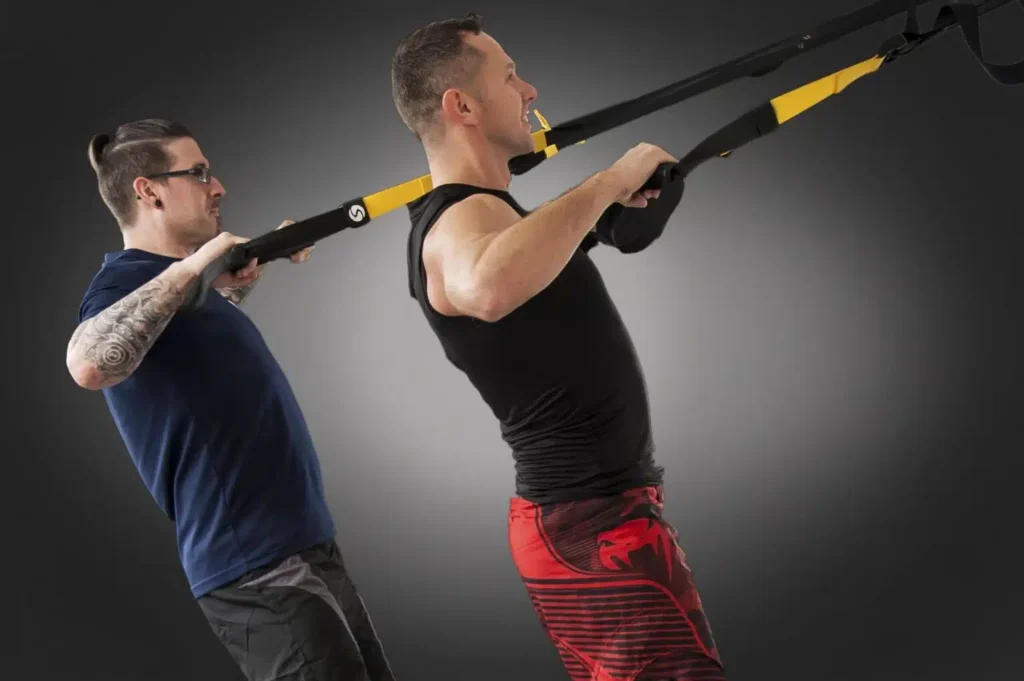
Inverted rows are one of our favourite back exercises for people who are developing the strength required for pull-ups.
The original article correctly included inverted rows because they target the lats, rhomboids, and upper-back muscles.
Position yourself underneath a secure bar. Grip the bar and keep your body relatively straight from your shoulders through your hips and legs.
Pull your chest towards the bar by driving your elbows backwards and bringing your shoulder blades together. Lower yourself under control.
The angle of your body affects the difficulty.
A more upright body position generally makes the exercise easier. Moving towards a more horizontal position increases the amount of bodyweight you need to move.
You can therefore progress the exercise without immediately adding external weight.
Always use a properly secured bar or purpose-built equipment. Unstable household furniture is not an appropriate substitute.
4. Scapular Pull-Ups
Scapular pull-ups teach an important part of pulling mechanics without requiring you to perform a complete pull-up.
Hang from a secure pull-up bar with your arms extended.
Rather than bending your elbows and pulling your chin towards the bar, focus on moving your shoulder blades down while slightly lifting your body. Pause briefly before returning to the starting position under control.
The movement is intentionally small.
This exercise helps you practise initiating a pull from your shoulder blades rather than relying entirely on your arms.
Try 6 to 10 controlled repetitions instead of rushing through a large number.
Scapular pull-ups can work particularly well as part of your warm-up before regular pull-ups or chin-ups.
If hanging causes shoulder discomfort, do not force the exercise. Exercise selection should always reflect your current mobility, strength, and injury history.
A trainer can help you find another movement if hanging exercises are not appropriate for you.
5. Reverse Snow Angels
Not everyone has access to a pull-up bar. Reverse snow angels provide an equipment-free option that can be performed on the floor.
Lie face down with your arms positioned near your sides.
Keeping your movements slow, sweep your arms outwards and overhead in a wide arc before bringing them back towards your sides. Think about controlling your shoulder blades rather than simply moving your hands as quickly as possible.
Keep the range comfortable.
You should not force your shoulders into a position that causes pinching or pain.
Try approximately 8 to 12 controlled repetitions.
Reverse snow angels do not replace heavy rowing or vertical pulling when maximum back strength is the goal. However, they can complement a broader bodyweight back workout and are particularly convenient for home training.
They also teach you to pay attention to shoulder blade movement, which can carry over into exercises such as rows and pull-ups.
6. Prone Y Raises
Prone Y raises look simple, but controlled repetitions can be surprisingly challenging.
Lie face down with your arms extended diagonally overhead so your body and arms create a Y shape.
Keep your neck in a comfortable neutral position.
Gently lift your arms a short distance while concentrating on controlled movement around the shoulder blades. Pause briefly, lower your arms, and repeat.
You do not need to lift your hands high from the floor.
The quality of the movement matters more than range.
Begin with around 8 to 12 repetitions. If maintaining good technique becomes difficult, stop the set rather than continuing with increasingly poor form.
This is particularly useful as an accessory movement rather than the main strength exercise in your workout.
Combine it with stronger pulling exercises such as inverted rows or pull-ups when equipment is available.
Small exercises have a place in training, but they work best when included as part of a complete program rather than treated as a replacement for every other back movement.
7. Prone T Raises
Prone T raises use a similar starting position to Y raises but change the direction of your arms.
Lie face down and extend your arms directly out to each side, creating a T shape.
With your neck relaxed, gently raise your arms from the floor while bringing your shoulder blades towards each other. Pause, then lower slowly.
Avoid shrugging your shoulders towards your ears.
You can start with 8 to 15 repetitions depending on your current strength and control.
The exercise should feel deliberate rather than fast.
Prone T raises can be paired with Y raises to introduce different shoulder positions into your bodyweight back workout.
We often remind members that an effective training program does not need every exercise to feel exhausting.
Controlled accessory movements can help develop awareness and strength in areas that larger exercises sometimes fail to emphasise.
If the movement causes shoulder discomfort, reduce your range or speak with a qualified trainer about a more suitable alternative.
8. Superman Exercise
The Superman is an equipment-free floor exercise that introduces trunk extension into your back routine.
Lie face down with your arms extended forwards or positioned in a comfortable variation.
Gently lift your chest and legs a small distance from the floor while keeping the movement controlled. Hold briefly, then lower yourself.
Avoid trying to create the biggest possible arch through your lower back.
A small controlled movement is enough.
You can begin with 6 to 10 repetitions, using a short pause at the top.
The Superman is different from pull-ups and rows because it does not primarily target the lats through pulling. Instead, it challenges muscles along the posterior side of your body.
People with existing lower-back problems should be cautious with extension-based exercises.
Pain is not a sign that an exercise is working. If the movement causes discomfort, stop and seek appropriate professional guidance before continuing.
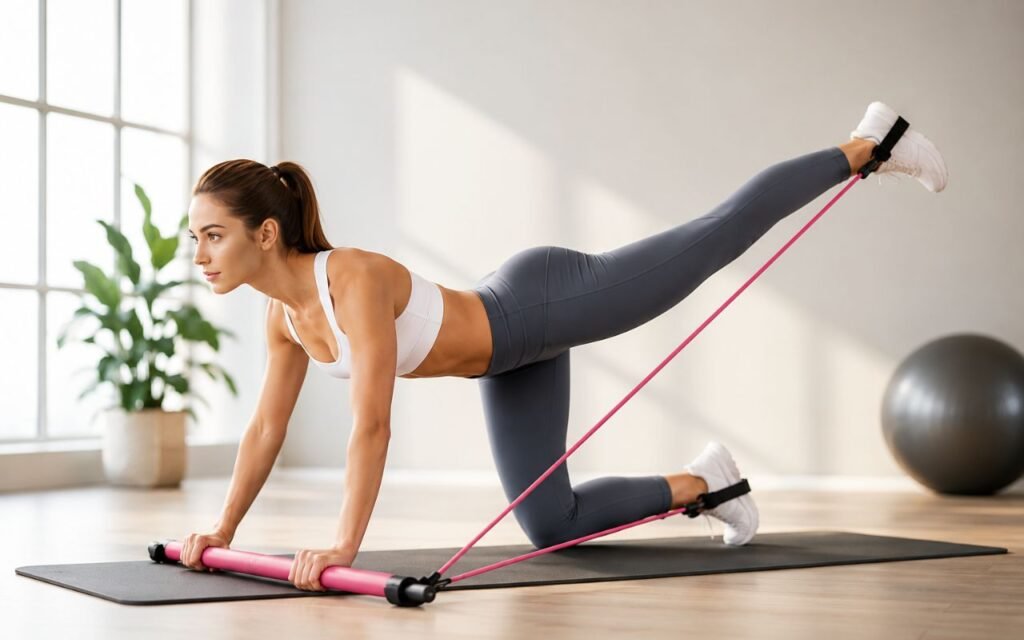
9. Bird Dog
Bird dogs are useful when your goal extends beyond building visible back muscles and includes trunk control and stability.
Begin on your hands and knees with your hands beneath your shoulders and knees beneath your hips.
Brace your midsection gently.
Extend one arm forwards while extending the opposite leg backwards. Keep your hips relatively level rather than rotating your body.
Pause briefly before returning to the starting position and changing sides.
Start with approximately 6 to 10 controlled repetitions on each side.
The exercise becomes much less effective when performed quickly.
Think about keeping your body stable while your arm and leg move around it.
Bird dogs can work particularly well during warm-ups, beginner strength sessions, or as an accessory exercise alongside rows and pull-ups.
For people new to training, mastering this type of controlled movement can establish a useful foundation before progressing towards more demanding exercises.
10. Bodyweight Back Extensions
Bodyweight back extensions can help train the muscles responsible for extending and stabilising the trunk.
If your gym has a back-extension bench, position yourself correctly so the equipment supports your hips while allowing your upper body to move comfortably.
Start in a controlled position and lower your torso through an appropriate range.
Use your posterior-chain muscles to return until your body reaches a neutral position.
Avoid aggressively hyperextending your lower back at the top.
If you do not have access to appropriate equipment, floor-based trunk-extension variations can provide an alternative.
Start conservatively with approximately 8 to 12 repetitions.
Your technique should remain controlled throughout every repetition.
Back extensions should complement your pulling exercises rather than replace them.
A well-designed program combines movements for the upper and lower back instead of repeatedly training only one area.
If you have an existing back injury or persistent pain, obtain professional guidance before adding extension exercises to your program.
How to Create a Bodyweight Back Workout
You do not need all 10 exercises in a single session.
A more practical approach is choosing movements that cover different functions while matching your current ability.
For example, an intermediate workout could include:
- Pull-ups for 3 sets of 5 to 8 repetitions
- Inverted rows for 3 sets of 8 to 12 repetitions
- Scapular pull-ups for 2 sets of 6 to 10 repetitions
- Prone Y or T raises for 2 sets of 10 to 15 repetitions
- Bird dogs for 2 sets of 8 repetitions per side
Beginners can use assisted versions and reduce the number of sets.
Rest enough between sets to maintain good technique.
As you improve, progress by adding repetitions, increasing the range of motion, choosing a harder variation, slowing the lowering phase, or adjusting your body position.
Progress should be gradual. Making every exercise harder at the same time is rarely necessary.
How Often Should You Train Your Back?
Training frequency depends on your overall program, experience, recovery, and goals.
For many recreational gym members, training major muscle groups at least twice across the week can be a practical starting point. However, total weekly training volume and recovery matter just as much as frequency.
You do not need to train your back hard every day to make progress.
Your muscles need time to recover and adapt after challenging sessions.
Pay attention to how your back, shoulders, elbows, and grip feel between workouts. Persistent soreness or declining performance may indicate that your training needs adjusting.
At EFM Glenelg, we prefer building routines people can maintain consistently rather than creating unnecessarily exhausting programs.
Two well-planned sessions performed every week will usually be more useful than an extreme routine that you abandon after a fortnight.
Consistency gives you the opportunity to practise good technique, monitor progress, and gradually increase the challenge.
Common Bodyweight Back Training Mistakes
Bodyweight training can look straightforward, but technique still matters.
One common mistake is choosing exercises that do not match the goal. The original version of this article, for example, included squats and lunges even though these primarily target the legs.
Another issue is relying too heavily on momentum during pull-ups and rows.
Watch for these common problems:
- Swinging through pull-ups instead of controlling each repetition
- Performing repetitions too quickly
- Using unstable furniture as exercise equipment
- Increasing difficulty before mastering technique
- Ignoring pain in the shoulders, elbows, or lower back
- Training only one movement pattern
Your back benefits from variety.
Combine vertical pulling, horizontal pulling, shoulder blade control, trunk stability, and appropriate posterior-chain work.
Good training is not about making every exercise as difficult as possible. It is about choosing the right challenge and progressing from there.
Can You Build Your Back Without Weights?
Yes, bodyweight exercises can build back strength, particularly for beginners and intermediate trainees.
However, there is an important limitation.
Your back is designed to perform pulling movements, so completely equipment-free back training can be more restrictive than bodyweight training for muscles such as the chest or legs.
A secure pull-up bar or rowing station gives you considerably more training options.
As you become stronger, progressive overload also becomes important.
You might progress from assisted pull-ups to full pull-ups, change your inverted-row angle, increase repetitions, use slower eccentric phases, or eventually introduce external resistance.
The best approach depends on your goal.
If you simply want better general strength and movement, bodyweight training may provide plenty of challenge.
If your goal is substantial muscle growth or advanced strength, combining bodyweight exercises with resistance training can make progression easier to measure and manage.
Final Thoughts
The best bodyweight back exercises are the ones that genuinely challenge the muscles of your back while allowing you to maintain good technique.
Pull-ups, chin-ups and inverted rows provide strong pulling movements. Scapular pull-ups, Y raises, T raises and reverse snow angels can complement them with controlled shoulder blade work. Bird dogs, Superman variations and back extensions introduce trunk stability and posterior-chain training.
The original EFM Glenelg article highlighted the convenience of bodyweight exercise and the value of movements such as pull-ups and inverted rows for developing back strength. This updated approach makes the routine more specific to the back rather than mixing it with unrelated lower-body and pushing exercises.
At EFM Glenelg, our focus is on helping members train with purpose, appropriate technique, and steady progression. Start at your current ability, master each movement, and gradually make your workouts more challenging as you become stronger.