Building a strong, balanced chest requires more than performing the same flat bench press every week. If you want fuller chest development, your program can benefit from exercises that place greater emphasis on the clavicular portion of the pectoralis major, commonly referred to as the upper chest.
The best upper chest exercises usually involve incline pressing, upward cable movements and selected bodyweight exercises. Research has shown that changing the bench angle can influence muscle activation across different portions of the pectoralis major. Incline pressing can increase activity in the clavicular region compared with flat pressing, although shoulder involvement also tends to increase as the angle becomes steeper.
At EFM Glenelg, we prefer a balanced approach. You do not need to perform every upper chest exercise in the same workout. A few well-selected movements, performed consistently with good technique and gradual progression, can provide plenty of training stimulus.
What Is the Upper Chest?
The chest is primarily formed by the pectoralis major, a large muscle that contributes to movements of the shoulder and upper arm.
When people talk about the upper chest, they are generally referring to the clavicular portion of the pectoralis major. These fibres originate closer to the collarbone and contribute to movements where the arm travels upwards and across the body.
It is important to understand that the upper chest is not a completely separate muscle that can be isolated from the rest of the pectoralis major.
Instead, exercise angle can influence which fibres receive relatively more emphasis.
This is why incline presses and certain cable movements are commonly included in an upper chest workout.
Research examining different bench angles has found that the clavicular portion of the pectoralis major can show greater activity during inclined pressing conditions compared with flat pressing.
The goal is therefore not isolation. It is intelligent exercise selection within a balanced chest program.
Benefits of Training Your Upper Chest
Upper chest training can contribute to a fuller and more balanced chest while also developing pressing strength through different movement angles.
If your program consists almost entirely of flat presses, adding incline movements gives your chest and shoulders a slightly different challenge.
This can be particularly useful for people interested in muscle development, general upper-body strength or sporting movements that require pressing at different angles.
Upper chest exercises also involve other muscles. Your triceps and front shoulders contribute substantially during most incline presses, which makes these movements efficient compound exercises.
The important point is balance.
You do not need an entire workout dedicated exclusively to one small area of your chest. Incline exercises can simply form part of your broader resistance-training program.
Current American College of Sports Medicine guidance emphasises consistent training of all major muscle groups and sufficient weekly volume rather than overly complicated exercise selection.
That is the approach we recommend at EFM Glenelg.
Best Upper Chest Exercises at a Glance
Different exercises can train the upper chest through pressing, adduction and bodyweight movement patterns.
| Exercise | Main Muscles | Equipment | Suggested Reps |
|---|---|---|---|
| Incline barbell bench press | Upper chest, triceps, shoulders | Barbell and bench | 6 to 10 |
| Incline dumbbell press | Upper chest, triceps, shoulders | Dumbbells | 8 to 12 |
| Incline dumbbell fly | Chest | Dumbbells | 10 to 15 |
| Low-to-high cable fly | Upper chest | Cable machine | 10 to 15 |
| Smith machine incline press | Upper chest, shoulders, triceps | Smith machine | 8 to 12 |
| Feet-elevated push-up | Chest, shoulders, triceps | Bench or box | 8 to 20 |
| Incline machine chest press | Upper chest, shoulders, triceps | Machine | 8 to 12 |
| Dumbbell pullover | Chest, lats, triceps | Dumbbell and bench | 8 to 15 |
These repetition ranges are practical examples rather than strict requirements.
Choose resistance that challenges you while still allowing controlled technique.
1. Incline Barbell Bench Press
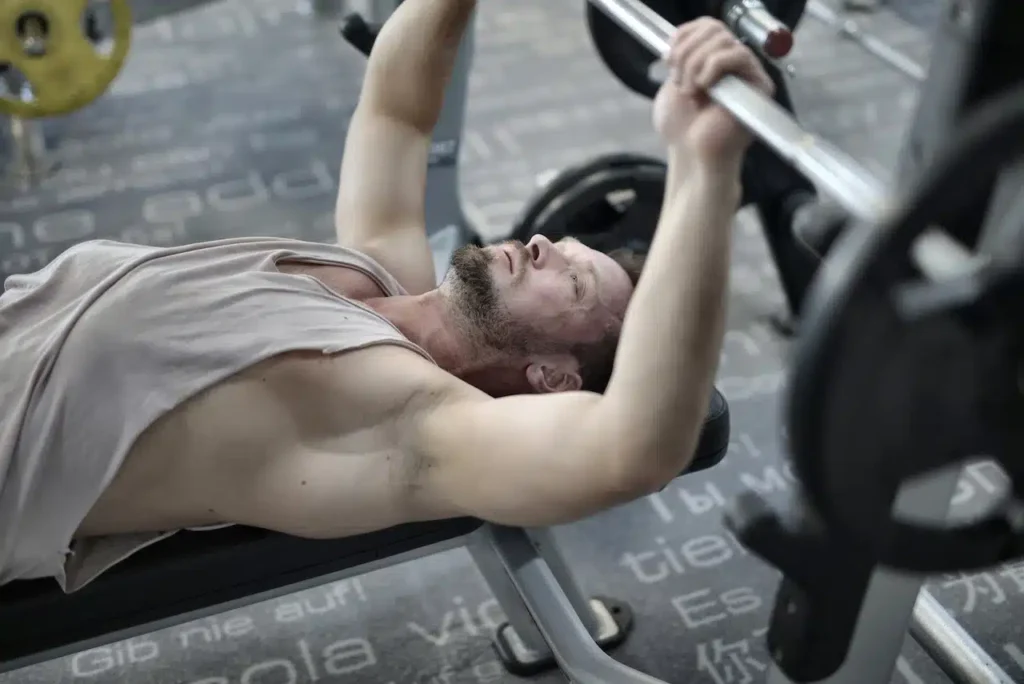
The incline barbell bench press is one of the most widely used upper chest exercises because it allows you to train with substantial resistance while working the chest, shoulders and triceps together.
You do not necessarily need to set the bench at 45 degrees.
Research comparing bench angles has shown that changing the incline affects both chest and anterior shoulder activation. Higher inclines can increase clavicular chest activity, but they can also place greater emphasis on the front deltoids.
For many gym members, a moderate incline provides a comfortable compromise.
Set your upper back securely against the bench and keep your feet stable. Lower the bar under control towards your upper-to-mid chest region, then press upwards without bouncing the weight.
Avoid choosing such a heavy load that your movement becomes inconsistent.
If you are new to incline pressing, learn the exercise with manageable resistance before increasing the weight.
2. Incline Dumbbell Press
The incline dumbbell press follows a similar movement pattern to the barbell version but allows each arm to move independently.
This can provide greater freedom of movement around the shoulders and makes it easier to identify differences between your left and right sides.
Set the bench to a moderate incline and begin with the dumbbells positioned near your upper chest. Press them upwards while maintaining control rather than aggressively bringing them together.
Lower the weights gradually until you reach a comfortable range of motion.
You do not need to force your elbows excessively below the bench simply to create a deeper stretch.
Dumbbells can be particularly useful for people who find a fixed barbell hand position uncomfortable.
At EFM Glenelg, we often use dumbbell variations because the resistance can be adjusted easily and the exercise can be progressed gradually.
For muscle-focused training, somewhere around 8 to 12 controlled repetitions per set can provide a practical starting point, although different ranges can still be effective.
3. Incline Dumbbell Fly
The incline dumbbell fly is an accessory chest exercise rather than a heavy strength movement.
Unlike a press, where your elbows bend substantially and your triceps assist, a fly keeps a more consistent elbow angle and places greater emphasis on bringing your arms across the body.
Set the bench to a modest incline and begin with the dumbbells above your chest.
Maintain a slight bend in your elbows while gradually opening your arms. Stop when you feel a comfortable stretch through your chest rather than trying to lower the dumbbells as far as possible.
Bring your arms back together under control.
This exercise generally works better with moderate or lighter resistance.
Trying to perform flies with the same weights you use for pressing often causes technique to deteriorate quickly.
We usually consider incline flies an accessory movement after your main pressing exercises.
They can add useful training volume, but they do not need to replace stronger compound movements such as incline dumbbell or barbell presses.
4. Low-to-High Cable Fly
The low-to-high cable fly is one of the more useful exercises for upper chest training because the direction of resistance follows an upward and inward path.
Position the cable handles around the lower part of the machine. Step forward into a stable stance and begin with your arms slightly out to the sides.
Bring the handles upwards and towards each other in front of your upper chest.
Keep your elbows slightly bent and avoid turning the movement into a press.
Cable resistance has the advantage of remaining present throughout much of the exercise, unlike dumbbells where the direction of gravity stays constant.
However, you still do not need heavy resistance.
The objective is to control the movement and maintain tension rather than use momentum.
Low-to-high cable flies can work particularly well after incline pressing exercises when you want additional chest work without requiring another heavy compound movement.
Around 10 to 15 repetitions can provide a practical starting range for many recreational lifters.
5. Smith Machine Incline Bench Press
A Smith machine incline press provides a fixed bar path, which can make pressing feel more stable than a free-weight barbell variation.
This can be useful for people who want to focus on applying force through the chest and shoulders without needing to stabilise the bar in multiple directions.
Set the bench underneath the machine so the bar travels comfortably towards your upper chest.
Your exact bench position will depend on the machine design.
Keep your shoulders and upper back secure against the bench while lowering the bar under control.
The fixed bar path does not automatically make the exercise safer for everyone. You still need to position the bench correctly and choose an angle that feels comfortable for your shoulders.
Smith machine presses can be particularly useful during muscle-building sessions because they allow progression without requiring as much stabilisation as a free barbell.
Use them as one option rather than believing they are automatically better or worse than free weights.
6. Feet-Elevated Push-Ups
Feet-elevated push-ups provide a useful bodyweight option for increasing the demand on the upper portion of the chest and shoulders.
Place your feet on a stable bench or box while keeping your hands on the floor. Your body should remain relatively straight from your shoulders to your feet.
Lower yourself under control until your chest approaches the floor, then press back to the starting position.
The higher your feet are elevated, the more demanding the movement generally becomes.
However, raising them excessively can shift more work towards the shoulders and turn the exercise into something closer to a vertical press.
Start with a modest elevation.
If regular floor push-ups are already difficult, there is no need to progress to feet-elevated versions yet.
Build strength with standard or hands-elevated push-ups first.
For experienced members, feet-elevated push-ups can work well as an accessory movement or as a high-repetition finisher after heavier pressing exercises.
7. Incline Machine Chest Press
An incline chest press machine can be an excellent option for beginners and experienced gym members alike.
The machine provides a guided movement path, allowing you to focus more heavily on pressing without having to stabilise free weights.
Adjust the seat so the handles begin around a comfortable upper-chest position.
Keep your upper back supported and press smoothly without locking your elbows aggressively at the top.
Return the handles slowly rather than letting the machine pull the resistance backwards.
Machines are particularly useful later in a workout when fatigue has accumulated.
You may find it easier to maintain consistent technique than with dumbbells after several demanding sets.
However, every machine has a slightly different design.
If the movement path feels uncomfortable for your shoulders, adjust the seat or choose another pressing variation rather than forcing your body to match the machine.
A good exercise should challenge the target muscles without creating unnecessary joint discomfort.
8. Dumbbell Pullover
The dumbbell pullover is sometimes included in chest programs, although it should not be considered a highly specific upper chest exercise.
It involves both the chest and back musculature and places your shoulders through a large range of motion.
Lie securely on a bench and hold one dumbbell above your chest with both hands.
Keeping a slight bend in your elbows, slowly lower the dumbbell behind your head until you reach a comfortable range. Return it to the starting position without using momentum.
Do not force the stretch.
Shoulder mobility varies considerably between people, and going further does not automatically make the exercise more effective.
At EFM Glenelg, we would generally treat pullovers as an optional accessory exercise rather than the foundation of an upper chest workout.
If your main goal is upper chest development, incline presses and low-to-high cable movements deserve greater priority.
Use pullovers when they fit comfortably into your broader upper-body program.
What Bench Angle Is Best for the Upper Chest?
There is no single perfect incline angle for every person.
Research comparing bench press angles provides useful guidance but also shows why the answer is not as simple as setting every bench to 45 degrees.
One study comparing 0, 28, 44 and 56-degree positions found greater clavicular pectoralis activation at some of the steeper angles, but anterior deltoid activity also increased as the bench was inclined.
Another study examined 0, 30, 45 and -15-degree bench conditions and similarly found that changing the angle altered chest and shoulder activation.
For practical training, a moderate incline around 20 to 45 degrees can provide a useful range to experiment with.
Your shoulder comfort and ability to control the movement should influence the final choice.
You do not need to chase an exact number if another angle feels stronger and more comfortable for your body.
How to Structure an Upper Chest Workout
A good upper chest workout does not require all eight exercises from this guide.
For most people, two or three upper-chest-focused movements within a broader chest or upper-body session can provide enough stimulus.
Start with a compound press while you are fresh. Follow that with another pressing or bodyweight exercise, then finish with a cable or fly movement if you need additional volume.
For example:
- Incline barbell press for 3 sets
- Incline dumbbell press for 3 sets
- Low-to-high cable fly for 3 sets
That gives you nine working sets without making the session unnecessarily complicated.
Current ACSM guidance suggests that higher weekly training volume, around 10 sets per muscle group, can be useful for hypertrophy, although individual needs vary.
Remember that flat pressing and other chest exercises also contribute to total chest volume.
More exercises are not automatically better. Quality, progression and recovery still matter.
How Many Sets and Reps Should You Do?
The right repetition range depends on your goals and the exercise.
For heavier compound movements such as incline barbell presses, sets of roughly 6 to 10 repetitions can provide a practical combination of strength and muscle-building work.
Dumbbell and machine presses may work comfortably around 8 to 12 repetitions.
Cable flies and similar accessory exercises are often practical in slightly higher ranges, such as 10 to 15 repetitions.
These numbers are not strict muscle-building boundaries.
The resistance simply needs to provide enough challenge while allowing you to maintain appropriate technique.
ACSM’s 2026 resistance-training position stand reviewed more than 137 studies and data involving over 30,000 participants. Its overall message places considerable importance on consistent resistance training rather than unnecessarily complicated programming.
For most gym members, two to four working sets per exercise can be enough.
Start conservatively, monitor your recovery and gradually add training volume when there is a clear reason to do so.
Progressive Overload for Upper Chest Growth
Your muscles adapt to repeated training. If the challenge never changes, progress may eventually slow.
Progressive overload means gradually increasing that challenge over time.
Adding weight is one option, but it is not the only one.
You might increase repetitions, improve your range of motion, add a set or perform the same load with better control.
Suppose you currently perform an incline dumbbell press for three sets of eight repetitions. Over several sessions, you may gradually reach three sets of ten.
Once that becomes manageable with good technique, you could increase the resistance slightly and begin building your repetitions again.
This creates measurable progression without requiring large jumps in weight.
Keep a basic record of your workouts.
At EFM Glenelg, we find that training logs help members see progress that might otherwise be overlooked.
Strength improvement often occurs gradually. Small increases repeated over several months can produce meaningful changes in both performance and muscle development.
Common Upper Chest Training Mistakes
One of the biggest mistakes is believing that more incline automatically means more upper chest.
As the bench becomes steeper, your shoulders generally contribute more to the exercise.
Another problem is using too much weight and losing control of the movement.
Common mistakes include:
- Setting the incline unnecessarily high
- Using excessive resistance
- Bouncing the bar from the chest
- Allowing shoulders to roll forward under load
- Performing too many pressing exercises in one session
- Ignoring pulling and back exercises
- Changing exercises before you can measure progress
- Training through persistent shoulder pain
You should also avoid believing you can completely isolate the upper chest.
Exercise angles can influence muscle recruitment, but the pectoralis major still works as an integrated muscle.
Build your overall chest and upper body while using incline movements to provide additional emphasis where appropriate.
Balanced training will generally be more useful than trying to target one small area exclusively.
How Often Should You Train Your Upper Chest?
You do not necessarily need a separate upper chest day.
For many people, including upper chest exercises during one or two weekly upper-body or chest sessions is more practical.
Current resistance-training recommendations emphasise working all major muscle groups at least twice weekly for many healthy adults.
That does not mean every session needs to contain the same movements.
For example, one session might include incline dumbbell presses, while a later session uses a flat press and low-to-high cable fly.
This variation can distribute your workload while still providing repeated training stimulus.
Recovery matters as well.
If your chest and shoulders remain highly fatigued when the next session arrives, adding more volume is unlikely to improve the situation.
At EFM Glenelg, we prefer schedules that people can repeat consistently.
Training frequency should support your progress, not leave you permanently sore or unable to perform your next workout effectively.
Upper Chest Exercises for Beginners
Beginners do not need advanced exercises or heavy barbell pressing to start developing the chest.
A machine incline press can provide a controlled introduction to pressing. Light dumbbell presses can also help you learn how to stabilise resistance independently.
Push-ups are another useful option.
The main priority should be learning the movement before increasing the resistance.
A simple beginner session might include an incline machine press, a push-up variation and a light cable exercise.
Two or three exercises are plenty.
As your technique improves, resistance and exercise complexity can gradually increase.
Professional guidance can be useful during this stage because a trainer can observe your movement and suggest changes to bench position, resistance or exercise selection.
At EFM Glenelg, we regularly adjust exercises to match the member rather than expecting beginners to copy experienced lifters.
Do You Need to Train the Upper Chest Separately?
Not necessarily.
Your upper chest already contributes during many pressing movements, including flat bench presses and push-ups.
Adding dedicated incline work simply provides an opportunity to change the emphasis.
This distinction is important because fitness content sometimes makes chest training more complicated than it needs to be.
You do not need separate workouts for every small region of a muscle.
A balanced chest program might include a flat press, an incline press and a cable or fly movement. That alone can provide several different movement angles.
Your overall weekly training matters more than finding a supposedly perfect exercise.
This also helps keep your sessions manageable.
If you continually add exercises for the upper, middle and lower chest individually, training volume can become excessive quickly.
Instead, choose a small number of effective movements and improve them over time.
Consistency and progressive resistance will usually contribute far more to your results than endlessly searching for new exercise variations.
Why You Should Balance Chest Training With Back Exercises
Chest training should be part of a balanced upper-body routine.
Pressing exercises develop your chest, front shoulders and triceps, but you also need pulling movements to train your back and biceps.
Rows, pull-ups and lat pulldowns can provide that balance.
This does not mean you need exactly the same number of pushing and pulling sets in every single workout.
However, regularly neglecting your back while completing large amounts of chest training creates an incomplete program.
At EFM Glenelg, we generally encourage people to think in terms of movement patterns rather than individual muscles alone.
Can your program include horizontal pushing, horizontal pulling, vertical pushing and vertical pulling?
That broader approach develops upper-body strength more comprehensively.
If you are planning a complete training routine, read our guide to upper body compound exercises alongside your chest training.
Building powerful pecs may be your immediate goal, but a strong and capable upper body should remain the bigger priority.
Final Thoughts
The best upper chest exercises include incline barbell presses, incline dumbbell presses, low-to-high cable flies, machine presses and appropriately progressed push-up variations.
You do not need to perform all of them in one workout.
Select two or three exercises that suit your ability, use an incline angle that feels comfortable and progressively increase the challenge as your strength develops.
Research shows that bench angle can influence activity across different portions of the chest, but increasingly steep angles also involve more of the anterior shoulders. This is why good exercise selection involves more than simply setting the bench as high as possible.
At EFM Glenelg, we have spent more than 15 years helping members build strength through practical, structured training.
If you want help putting together an upper chest workout or broader strength program, our trainers can help you select exercises that suit your goals, experience and current fitness level.