Building stronger, more defined arms takes more than doing random curls every time you visit the gym. A balanced arm workout should train the biceps, triceps, and forearms while also developing grip strength and supporting overall upper-body performance.
For beginners, the best approach is simple. Learn proper technique, choose manageable resistance, and gradually increase the challenge as your strength improves. You do not need dozens of exercises or complicated training methods to make progress.
The best arm workout exercises for beginners combine basic resistance movements with controlled repetitions and consistent training. Dumbbells, resistance bands, cable machines, and bodyweight exercises can all play an important role.
In this guide, we will cover the equipment you need, effective exercises for each major arm muscle group, training techniques, and recovery strategies that can help you build stronger arms over time.
Essential Equipment for Effective Arm Training
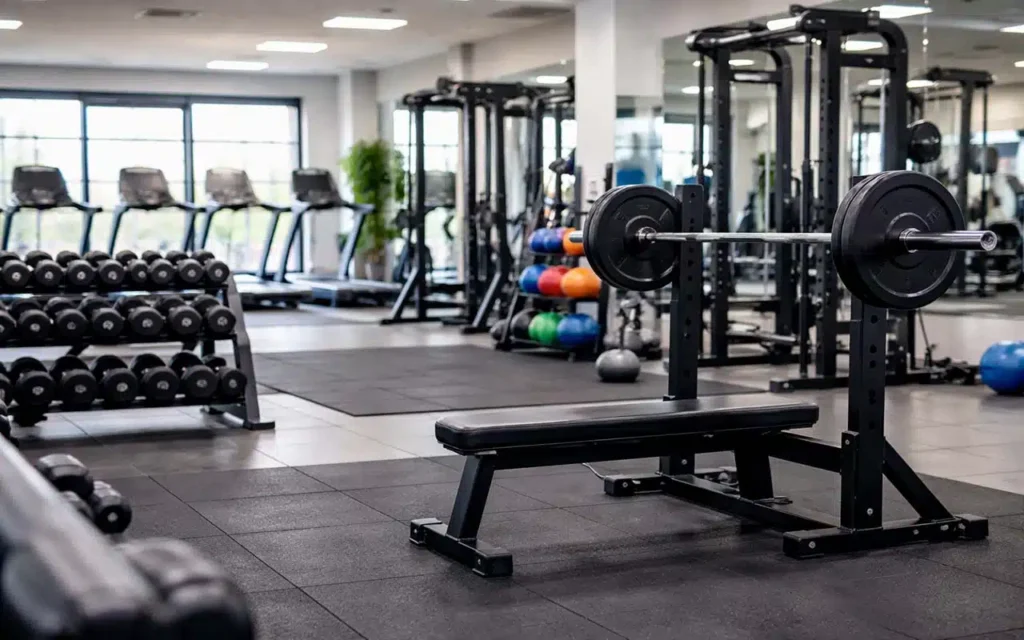
You do not need an extensive collection of gym equipment to train your arms effectively. A few versatile tools can provide enough resistance and exercise variety for beginners while leaving plenty of room for progression.
Dumbbells are one of the most useful options because each arm works independently. Resistance bands provide portable resistance and are useful for warm-ups, lighter training, and controlled isolation exercises.
Pull-up bars allow you to introduce compound bodyweight exercises such as chin-ups, while cable machines maintain resistance throughout the movement. Each option offers something different, so combining several types of equipment can make your arm workouts more balanced.
| Equipment | Best Used For | Space Required | Typical Cost Range |
|---|---|---|---|
| Dumbbells | Isolation and compound exercises | Medium | $100–$500 |
| Resistance bands | Portable training and activation | Minimal | $20–$60 |
| Pull-up bars | Bodyweight and functional strength | Small | $30–$200 |
| Cable machines | Constant-tension exercises | Large | $500–$3,000 |
The original equipment recommendations include dumbbells, resistance bands, pull-up bars, and cable machines as useful options for building a complete arm-training setup.
Dumbbells for Versatile Arm Training
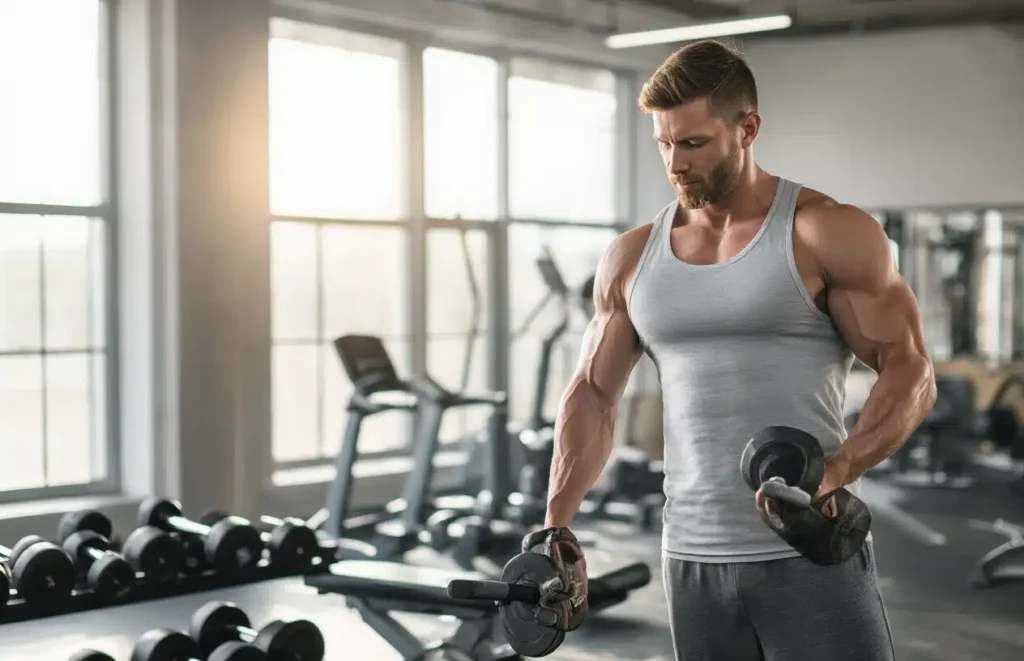
Dumbbells are an excellent starting point for beginners because they can be used for nearly every major arm muscle group.
Unlike many fixed machines, dumbbells require each side of your body to control its own weight. This can help you notice strength differences between your left and right arms while improving coordination.
For your biceps, you can perform traditional curls, hammer curls, and concentration curls. Your triceps can be trained with overhead extensions, kickbacks, and pressing movements.
You also have considerable flexibility when choosing resistance. Start with a weight that allows you to complete every repetition with good control rather than selecting the heaviest dumbbells you can lift.
As your technique and strength improve, gradually increasing resistance gives your muscles a reason to adapt.
Resistance Bands for Portable Training
Resistance bands are inexpensive, portable, and easy to incorporate into a beginner arm workout.
Unlike free weights, bands generally create greater resistance as they stretch. This means the exercise can become progressively more challenging through parts of the movement.
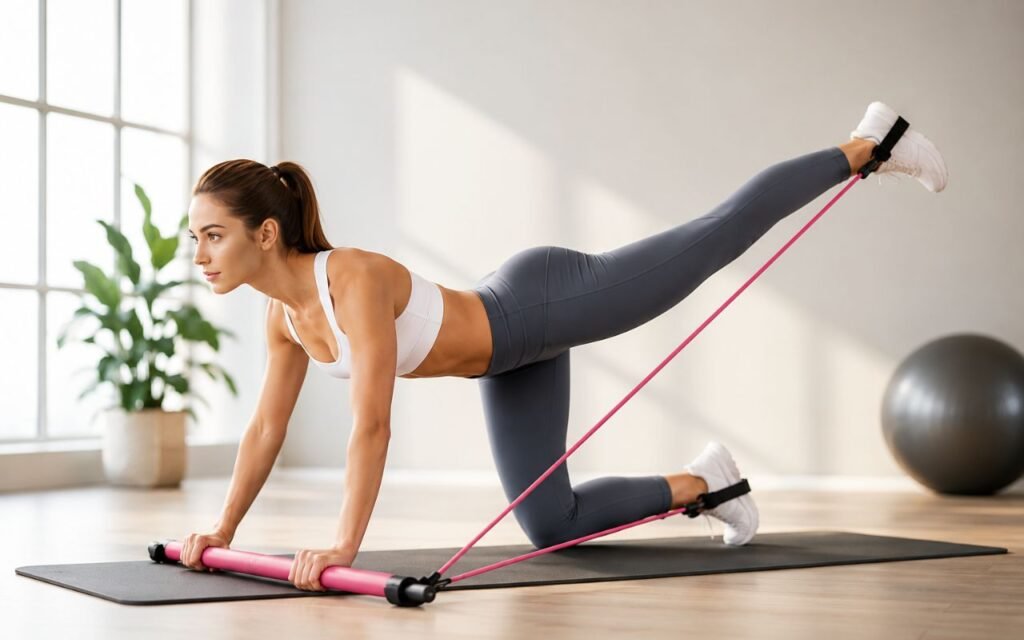
Bands can be used for bicep curls, tricep pushdowns, pull-aparts, extensions, and warm-up movements. They are particularly convenient if you train at home or want equipment you can take while travelling.
Different types of bands serve different purposes. Loop bands work well for activation exercises, while tube bands with handles can recreate some cable-machine movements. Flat resistance bands provide additional flexibility for different exercises and anchor positions.
Pull-Up Bars for Functional Arm Strength
A pull-up bar gives beginners access to some of the most effective bodyweight pulling exercises.
Although pull-ups are commonly associated with back training, your biceps and forearms also contribute significantly to the movement. Chin-ups, where your palms face toward you, place greater emphasis on the biceps.
Beginners who cannot yet complete a full chin-up can start with assisted repetitions or controlled negative repetitions. For a negative repetition, begin near the top position and slowly lower yourself.
Over time, improving your pulling strength can benefit more than your arms. It can also strengthen your back, grip, shoulders, and other muscles involved in upper-body pulling movements.
Cable Machines for Constant Resistance
Cable machines are another useful option for developing your arms because they maintain tension throughout much of an exercise.
You can adjust the height of the pulley and use different attachments to change the angle of resistance. This gives you plenty of options without needing to move between several pieces of equipment.
For biceps, low cable curls and rope hammer curls are effective choices. For triceps, rope pushdowns, straight-bar pushdowns, and overhead cable extensions provide several ways to train the muscle.
Cable exercises are also useful when you want to concentrate on controlled technique instead of simply moving heavy resistance.
Best Bicep Exercises for Beginners
Your biceps are located on the front of your upper arms and play an important role in bending your elbow and supporting pulling movements.
A beginner does not need five or six different curl variations during every workout. Two or three carefully selected movements are usually enough to provide effective training.
Barbell curls can be used for general strength and size. Hammer curls involve the biceps, brachialis, and forearms, while concentration curls provide a more isolated movement.
The key is maintaining control. Avoid swinging your body simply to move a heavier weight. Your biceps should perform the majority of the work.
1. Barbell Curls
Barbell curls are one of the most recognizable arm exercises and provide a straightforward way to train your biceps.
Stand with your feet approximately shoulder-width apart and hold the bar using an underhand grip. Keep your elbows close to your torso as you curl the bar upward.
Pause briefly near the top before lowering the weight under control.
Avoid leaning backwards or swinging your hips to generate momentum. If you cannot lift the bar without moving your entire body, reduce the resistance.
Beginners can aim for around 3 sets of 8 to 12 controlled repetitions, adjusting the weight according to their current ability. The original training guide also recommends prioritising control and technique rather than momentum during barbell curls.
2. Hammer Curls
Hammer curls are an excellent addition to a balanced arm workout because they train more than just the biceps.
Hold a dumbbell in each hand with your palms facing your body. Keep your elbows close to your sides and curl the dumbbells upward without rotating your wrists.
Pause briefly before slowly returning to the starting position.
The neutral grip places additional emphasis on the brachialis and forearm muscles. This makes hammer curls particularly useful for developing overall arm thickness and grip-related strength.
They can also provide a comfortable alternative for people who do not enjoy the fully supinated hand position used during conventional curls.
3. Concentration Curls
Concentration curls isolate one arm at a time and encourage slow, controlled movement.
Sit on a bench with your feet apart. Hold a dumbbell in one hand and position your elbow against the inside of your thigh.
Starting with your arm extended, curl the dumbbell upward while keeping your upper arm relatively still. Squeeze your biceps near the top before slowly lowering the weight.
Because you are seated and your arm is supported, there is less opportunity to use momentum.
Try approximately 10 to 15 controlled repetitions on each arm. Focus on feeling the biceps perform the movement rather than trying to lift unnecessarily heavy weights.
Best Tricep Exercises for Beginners
The triceps sit along the back of the upper arm and are an essential part of complete arm development.
A balanced workout should therefore include both pulling or curling movements for the biceps and extension or pressing movements for the triceps.
Close-grip push-ups, overhead tricep extensions, and dips provide several ways to train this area using body weight or external resistance.
Beginners should pay particular attention to elbow and shoulder positioning. Start with comfortable ranges of motion and progress gradually as your strength and technique improve.
4. Close-Grip Push-Ups
Close-grip push-ups shift more of the workload toward your triceps compared with a standard push-up.
Start in a push-up position with your hands closer together than you would normally place them. Keep your core engaged and maintain a relatively straight line through your body.
Lower yourself under control by bending your elbows, then push through your hands to return to the starting position.
If standard repetitions are too challenging, perform the movement from your knees or use an elevated surface such as a bench.
The exercise requires no specialist equipment, making it an excellent option for home workouts as well as gym sessions.
5. Overhead Tricep Extensions
Overhead tricep extensions place the triceps in a stretched position and can be performed with dumbbells, resistance bands, or cable machines.
Hold a dumbbell above your head with both hands. Keep your upper arms relatively stationary as you bend your elbows and lower the weight behind your head.
Once you reach a comfortable stretch, extend your elbows to bring the weight back upward.
Do not allow your elbows to flare excessively or your lower back to arch significantly.
Beginners should start with relatively light resistance until they become comfortable with the movement. A single-arm variation can also be used to train each side independently.
6. Tricep Dips
Dips are a compound exercise that can strengthen your triceps while also involving other upper-body muscles.
Depending on your ability and available equipment, they can be performed using parallel bars or an appropriate stable setup.
Lower your body by bending your elbows before pressing yourself back toward the starting position. Keep the movement controlled rather than dropping quickly into the bottom position.
Beginners should use an easier variation and a comfortable range of motion. As strength develops, the exercise can gradually become more challenging.
The original routine recommends adjusting difficulty according to foot position and progressing resistance as strength improves.
7. Diamond Push-Ups
Diamond push-ups are a challenging bodyweight movement that places considerable demand on the triceps.
Place your hands close together beneath your chest so your thumbs and index fingers create a roughly diamond-shaped position.
Keep your body controlled as you lower yourself toward your hands, then press back upward.
Do not be concerned if you cannot complete many repetitions initially. This is a demanding exercise.
Beginners can practise an easier version from their knees or with their hands elevated on a stable surface. As strength increases, gradually progress toward standard repetitions.
Do Not Forget Your Forearms
Forearm strength affects more exercises than many beginners realize. Your grip contributes to curls, rows, pull-ups, deadlifts, and numerous everyday activities.
Direct forearm exercises can therefore complement your regular bicep and tricep training.
Wrist curls primarily work muscles on one side of the forearm, while reverse curls train the forearms and brachioradialis using an overhand grip.
Farmer’s walks provide another option by challenging you to maintain your grip while carrying weight. They also require your core and upper body to remain stable while you move.
Wrist Curls
Sit on a bench with your forearms supported on your thighs and your palms facing upward.
Hold light dumbbells or a barbell and allow your wrists to extend before curling them upward. Keep your forearms relatively still so the movement occurs mainly at your wrists.
Beginners can start with approximately 12 to 15 controlled repetitions.
Forearm muscles can fatigue quickly, so heavy resistance is not necessary when you are first learning the movement.
Reverse wrist curls can also be performed with your palms facing downward to train the opposite side of your forearms.
Reverse Curls
Reverse curls look similar to traditional barbell curls, but you use an overhand grip.
Stand upright with your elbows close to your sides. Curl the weight upward without swinging your torso and then slowly lower it.
You will probably need less resistance than you use for standard curls because your grip and forearms become more involved.
This exercise can help develop the brachioradialis and forearm muscles while still involving the biceps.
Farmer’s Walks
Farmer’s walks are simple but demanding.
Hold a heavy dumbbell or kettlebell in each hand and walk forward while maintaining good posture. Keep your shoulders controlled, your core engaged, and your steps steady.
Instead of counting repetitions, you can measure the exercise using time or distance.
As your grip becomes stronger, gradually increase the weight or distance.
Single-arm farmer’s walks provide another variation and increase the stability challenge because you must resist leaning toward the loaded side.
Advanced Arm Training Techniques
Beginners should spend most of their time mastering basic exercises before introducing advanced methods.
Once you have established consistent technique and training habits, methods such as supersets, drop sets, tempo training, and rest-pause sets can provide additional variety.
These techniques generally increase training difficulty without requiring an entirely different exercise program.
They should not replace good form, sensible progression, or adequate recovery. Instead, think of them as tools you can introduce after you have built a strong foundation.
Supersets
A superset involves performing two exercises consecutively with little or no rest between them.
For example, you could perform bicep curls followed by tricep extensions. This allows you to train opposing muscle groups efficiently.
Another approach is pairing two exercises targeting the same muscle group, although this can create substantially more fatigue.
Supersets are particularly useful when you have limited training time, but beginners should avoid turning every exercise into a superset.
Drop Sets
Drop sets extend an exercise after your muscles become fatigued.
You begin with a challenging resistance and perform your repetitions. You then reduce the resistance and immediately continue with another group of repetitions.
The original routine suggests reducing resistance by approximately 20 to 30 percent during a drop set.
This method can make relatively simple exercises extremely demanding, so it is better used selectively rather than on every set.
Tempo Training
Tempo training involves intentionally controlling how quickly you perform each part of a repetition.
Instead of quickly curling a dumbbell upward and letting it fall back down, you might spend several seconds lowering the resistance.
Slowing the movement increases the amount of time your muscles remain under tension and encourages greater control.
This can be particularly valuable for beginners because it shifts attention away from lifting the heaviest possible weight and toward performing each repetition correctly.
Recovery and Nutrition for Arm Development
Your workout provides the training stimulus, but recovery gives your body the opportunity to adapt.
Training your arms intensely every day is unlikely to be the fastest route to better results. Your muscles need adequate recovery between challenging sessions.
Nutrition also plays an important role. Your overall diet should provide enough energy and protein to support your training and recovery needs.
Hydration, sleep, and consistent eating habits matter too. Instead of relying on supplements or complicated routines, beginners will generally benefit more from establishing these fundamentals first.
Post-Workout Mobility and Stretching
After training, gentle mobility work can help you maintain comfortable movement through your shoulders, elbows, wrists, and arms.
Simple options include shoulder rolls, arm circles, tricep stretches, bicep stretches, and wrist mobility exercises.
You do not need an extensive stretching session. The source article suggests holding targeted stretches for around 20 to 30 seconds and incorporating approximately five minutes of post-workout stretching consistently.
The goal should be comfortable movement rather than forcing yourself into painful positions.
Protein and Muscle Recovery
Resistance training challenges muscle tissue, and adequate nutrition helps support the recovery process.
Protein-rich foods can form part of meals throughout the day. Examples include eggs, Greek yoghurt, lean meats, dairy products, and other suitable protein sources based on your diet.
Rather than focusing exclusively on a single post-workout meal, aim for consistent nutrition alongside your overall training program.
Your individual nutritional needs will vary according to your body size, activity level, training goals, and other factors.
Sleep Matters More Than You Think
Good sleep is one of the most overlooked parts of a successful training routine.
If you train consistently but regularly sleep poorly, your recovery and training quality can suffer.
The original guide recommends approximately 7 to 9 hours of quality sleep and emphasizes maintaining a consistent sleep routine.
Try to create a sleep environment that is comfortable, dark, and quiet. A consistent bedtime and wake-up schedule can also make it easier to develop better sleeping habits.
Sample Beginner Arm Workout
If you are unsure where to begin, keep your first routine simple.
| Exercise | Sets | Repetitions |
|---|---|---|
| Barbell or Dumbbell Curls | 3 | 8–12 |
| Hammer Curls | 3 | 10–12 |
| Close-Grip Push-Ups | 3 | 8–15 |
| Overhead Tricep Extensions | 3 | 10–12 |
| Reverse Curls | 2 | 10–15 |
| Farmer’s Walks | 2–3 | 20–40 seconds |
Choose resistance that allows you to complete the repetitions with good technique. When you can comfortably perform the upper end of the repetition range, consider gradually increasing the resistance.
Quality matters more than quantity, especially when you are learning.
Common Arm Workout Mistakes Beginners Should Avoid
One of the biggest beginner mistakes is trying to lift too much weight too soon. Swinging through curls or rushing through tricep exercises may allow you to move heavier resistance, but it can reduce your control over the movement.
Another common problem is training only the biceps. Your triceps and forearms deserve attention as well if your goal is balanced arm development.
Beginners should also avoid constantly changing their workout. Give yourself enough time to improve at your chosen exercises and track your progress.
Finally, remember that more training is not automatically better. Challenging workouts need to be balanced with appropriate rest and recovery.
Conclusion
The best arm workout exercises for beginners do not need to be complicated. Start with proven movements such as curls, hammer curls, close-grip push-ups, overhead tricep extensions, dips, and basic forearm exercises.
Build your routine around controlled technique and gradual progression. Dumbbells, resistance bands, pull-up bars, cable machines, and bodyweight movements can all provide effective resistance depending on what equipment you have available.
Most importantly, be consistent. Stronger arms develop through repeated quality training combined with appropriate recovery, nutrition, and sleep. The original article similarly emphasizes proper form, progressive training, and recovery as the foundation of long-term arm development.
Start with manageable resistance, master each movement, and increase the challenge gradually as you become stronger.